Independent Traveller


Travel in India is always a challenge.
The sheer volume of people places huge pressure of every aspect of every journey.  As a western visitor, or as one of India’s growing wealthy classes, it is possible to sidestep some of the crowds, but doing this throughout a visit misses the opportunity to sample real India.
Our opportunity came in the form of an invitation to visit friends in Vellore while staying in Bangalore just over 200 km away. “An easy train journey, just come for the day”.
The first challenge is getting a ticket.  The number of travellers mean that you can’t just turn up and travel, and buying a ticket means you seem to need to talk to most of the 1.4 million people employed by Indian Railways. You need to find the right booking office. You need to pick a train, there a lots of choose from.  You need to pick a class of travel, it’s not just first or second.  You need to decide if you want a confirmed booking or just to be wait-listed.  All these decisions should be easy, but everyone involved in the transaction has an opinion, as do lots of bystanders. “First Class air-con.Very comfortable”.
Eventually we find our way through the station crowds, a mix of travellers and others apparently just milling around watching the travellers, and start to negotiate the complexities of the ticketing scheme.  We identify a train. We decide on “non air-con”, previous experience telling us that air-con means you can’t see out of the windows.  We even get a confirmed ticket for at least part of the journey. Success.
We haven’t got anywhere yet, but we’ve managed the first step of being an independent traveller in India.

Slow in Vardo


It’s four o’clock in the afternoon and it’s already been dark for hours.  Today, as every day at this time, the south-bound Hurtigruten steamer stops briefly in the little Norwegian town of Vardo.
Not much happens in Vardo. Particularly in winter. The temperature is way below zero. The air is cold enough to sting as you breathe in. Everything is quiet.  The layer of snow on the ground deadens all sound.  The gently falling snow keeps everyone inside the brightly lit houses.
Through the treble-glazed windows of the “Nord Pol” bar I can see, but not hear, the locals sipping “Arctic” beer from the Mack brewery.
The only sign of outdoor activity in Vardo is down in the harbour.  A few packages are winched off the steamer and deposited into the snow on the quayside, before being hauled into the warehouse.  Further along the quay, a solitary small fishing boat comes in out of the darkness, and its two man crew unloads the fresh cargo in thickening snow flurries.
After a few minutes, the ship sounds its plaintive warning hooter summoning any stray passengers back aboard.  After another few minutes, the gangway is hauled away and the ship pulls out into the fjord.  The harbour gate clangs shut and lights start to go out. Vardo fades back into silence. The snow continues to fall.

Railway Lunch

Coonoor Station - Nilgiri Mountain Railway

"Would you like to share our lunch?"

We were sitting in an ageing carriage being slowly pulled by a wheezing steam train up the Nilgiri Mountain Railway in southern India. In the time of Empire thousands of colonial families would have used the same railway, and quite possibly the same carriages, to climb from the heat of the Indian Plains, up to the relative coolness of the hill station at Ooty.

We had started our journey from the Plains in a trusty Hindustan Ambassador before joining the train to complete the journey as it would have been done in the past. Our travelling companions were an Indian family escaping the hustle and bustle of city life in Madras to spend a few days in the hills.

The already slow train got slower and slower. After spending many hours on a mainline train before changing to the mountain train, the children were getting restless so their mother announced that it was now lunchtime. We were the only other travellers in the carriage, so the invitation came.

Palm-leaf plates were produced along with rice and an array of home-made pickles and chutneys. "They're not too hot", we were assured.  As the tea plantations slowly passed below the windows we had our first real taste of genuine home-cooked Indian hospitality.

If this scene had appeared in one of Michael Palin travelogues, we'd have been convinced that it was staged. In our travel anecdotes this lunch is now filed under "Palin moments".

Flavour of Svalbard

My trip to Svalbard in summer 2010 provided the opportunity to get really close to some of the polar bears there - I've put together a series of short blog posts about some of pictures I took.

1. Bear One


2. Bear Two


3. Bath Time


4. Being Watched


5. Planning a Picture


And if you want more words there is a blog post from 2010, or more pictures there is a set of images on Flickr.

Planning a picture


Just occasionally I manage to visualise a picture long before I get the chance to take it and then actually get to go and do it.   This picture falls into that category. 

I had a mental picture of a group of birds in silhouette flying across a glacier.  The opportunity was on the west coast of Svalbard where we had gone to watch a colony of little auks. 

Little auks build their nests underground, and every now and again a group would race out from under rocks and fly off round the bay, before coming back into the rocks to wait for the next swarm. 

Eventually I found a suitable perch, close to the colony, where the usual flight around the bay would lead the birds across a suitably icey backdrop.  After that it was just a matter of sitting wait for the sunlight to strike the glacier as the birds was coming back into the colony, and then pressing the shutter.

Being Watched


It's nice to be the centre of attention.  We thought we were here to watch the bears. We'd clearly got this bit wrong. The young bears get brought to watch us as a bedtime treat.

We had ventured out in the zodiacs for an evening watch, to see what was going on in the bay.  A mother with a couple of yearling cubs was out at the top of the bay.  The cubs were big enough to be curious about everything around them, but young enough to still need the reassurance that mum was going to be there to keep an eye on them.


As we drifted slowly to the head of the bay the three bears headed in our direction. They headed confidently across the floating ice getting as close as they could to us. Then the cubs just sat down and watched us watching them with mum in the background.  These guys were clearly very happy that this was their turf and we were interesting but temporary attractions.

Eventually mum decided that enough was enough and the cubs were reeled back in to get some sleep.

Bath Time


The zodiac crawls slowly round the headland and into the bay.  We've had a tip off.  There are bears here.  

We creep slowly in, eventually the bears come into view tucked away on the right hand side of the little bay.  They are right on the waters edge - mother and cub looking down onto an old bare whale skeleton.  They see us, we see them. Everyone stops. They try and figure if we are either a threat or a meal. Eventually they decide we are neither and everyone in the boat starts breathing again.

Then the show starts.  The stage is a old whale carcass, blown in on a storm many months ago.  From where we sit it's a bare skeleton, although we can see that the vertebrae are still connected.  From where the bear stands there is still lots of meat on the carcass - although it is underwater.  No problem for a polar bear - its not called ursus maritimus for nothing. 

Mum drops down onto the skeleton then dives under the water before coming up with a mouthful of meat - and soaks junior in the process. He has ventured along the spine too, picking his way tentatively along the vertebrae so he can stay as close to mum as possible. The inevitable happens - he get a little bit too ambitious in his scrambling, and finds out just how warm the arctic water is.

Bear Two


The first bear was seen on day one. The trip's going to be good.  We're ready for more. "We'll cruise the edge of the sea ice for a while, and see if anything turns up."  Sure enough - within a few minutes one of the old hands glances up from her book in the observation lounge, leans forward just to be sure, and cries "Bear, 9 o'clock". She's spotted an adult bear swimming strongly in the water just off the port side of the ship.  The message goes up to the bridge, and the boat heaves to. The next move is up to the bear.  

We're easy for the bear to spot - a 6000 tonne converted Russian spy ship is pretty obvious even when running quietly.  The bear comes in for a look, but decides that we're of limited interest -and certainly not edible - so soon swims away resuming his track towards the edge of the ice.  Lots of years of experience amongst the crew mean that we opt to sit still, in gathering mist, just to see what happens next.  We wait. The bear waits. Time passes.  Eventually the bear moves off inland away from the waters edge to explore a bit further.  We move in a little closer to the ice edge, and stop fast against the ice.  More time passes. The bear eventually decides that we deserve a closer inspection. So he picks himself up from his snooze and wanders towards us.  There's a  sudden cacophony of noise, every camera shutter fires. 

This is the close up chance of the trip. We might never see a bear this close again. He wanders closer and closer.  He follows the leads in the ice around the ship. Are there any of those nice Goretex-wrapped snacks around, so tempting in their bright yellow packaging.   He stands up to get a close look at the folks leaning over the edge - again the barrage of camera shutters. We get a really good look at him, he gets a really good look at us.  If there had been a gangway he'd probably have come aboard. That would probably have resulted in some great photographs, but would have been a problem to resolve.

In the absence of a gangway the bear eventually decided that it was time to stride majestically off over the ice.  He clambers over a nearby pressure ridge in the ice, and suddenly loses his footing, and slumps clumsily down though the ice. He then does exactly what you or I would do in the circumstance, he's looks round to see if anyone has noticed. Or course we had.  There were 100 Nikons or Canons pointed directly at him.  His majestic exit has been rumbled. 


Bear One


"There - just in from the back of the ice." "Where?" "I can't see anything." "I think you're imagining it." "No, really." "The slight creamy blob just to the right of the dark smudge on the ice face." "I think you might be right, good spot!"

The bear spotters dialog. Probably heard on every polar bear spotting trip to Svalbard.  Particularly around Bear One. The first bear of the trip.

Bear One on any Svalbard trip is always a big deal. It sets the tone of the trip. Is this going to be a good trip, or a great one. Did the first bear come early? If it did the trip was going to be a lucky one.

For first timers on the trip, it's always challenging to pick out the first ivory smudge in the far distance. For the old hands, its pretty easy. They've seen bears before. They know what empty ice looks like, and they know if there's a bear around.  Having spotted the bear, the next challenge is to take photographs.  Yes, it's just going to be a faint blob a few pixels across, but it is Bear One.  How many pictures of Bear One do you need? A few more will always be good.


Round the World in 20 days.


Having established that east is best (see previous post), how long would it really take to get round the world mostly by train?

Let's assume for the sake of argument that I'm going to set off eastwards tomorrow - at midday on Monday, 10th September 2012.

I'll catch the 12:01 from Oxford to London Paddington, then cross London to St Pancras to catch the Eurostar at 15:04, I'll be in Brussels just after 18:00, and in Cologne in time for dinner before catching the 22:28 heading eastward towards Moscow.

After a couple of nights and the intervening day, I'll get into Moscow's Byelorruski station at 09:37 on Wednesday morning.  The best direct train to Vladivostok, the Rossiya, runs every other day, so I've given myself the luxury of a static bed and time to have a look around Moscow before heading to Yaroslavski station on Thursday evening for the 23:45 departure and the long haul to Vladivostok, via Perm, Omsk, Krasnoyarsk, Ulan Ude and finally, after 9258 km, into Vladivostok in time for breakfast on Thursday 20th September. 

I'm going to forego the delights of Vladivostok, and head to the airport to catch the Korean Air flight to Seoul, where I’m going to reward myself with a static night before the overnight "time travel special" from Seoul to Vancouver (AC064) where by the quirks of the International Date Line I'll both depart and arrive on Friday 21st September.  Vancouver is one of my favourite North America cities so I’m going to make the longest stop of the trip and have a two night stop-over, before heading to Pacific Central station in Vancouver in time for the Sunday (23rd) departure of 'The Canadian' at 20:30.

I'm expecting to haul into Toronto station at about 09:30 on the 27th, before catching Train 60 to Montreal, then changing again for Train 14 to Halifax in Nova Scotia. That's another overnight train ride, which gets me into Halifax just after 17:10 on the 28th.  This time there’s not really enough time for sightseeing before I head to airport for the Air Canada (AC860) flight to London which gets me back into London at 09:35 on the 29th September, and I would expect to be back in Oxford by mid-day, about 456 hours after I left.

I played with a few variants of this trip, and found that the real trick to doing the trip quickly is getting the long train journeys to connect.  The Rossiya runs every other day, and the Canadian appears to run twice a week at this time of year.  A variant of this trip starting from Oxford on Sunday 9th got me back into London on Monday 24th – only 16 days.

If you're trying to track me down over the next few days email is probably the best bet, I’ll probably be in the office, but you never know. It'll all just depends how I feel tomorrow morning. 

The information in this post came from lots of websites – including Trainline, Man in Seat 61, Real Russia, Expedia, AirCanada and ViaRail.

My ‘final’ itinerary was

1
Monday 10 Sept
12:01 from Oxford, arrive Cologne 20:15, 
train to Moscow dep 23:45
2
Tuesday 11 Sept
En route
3
Wednesday 12 Sept
Arrive Moscow 09:37
4
Thursday 13 Sept
Depart Moscow 23:45
5
Friday 14 Sept
Perm (at 20:08),
6
Saturday 15 Sept
Omsk (14:03),
7
Sunday 16 Sept
Krasnoyarsk (09:36),
8
Monday 17 Sept
Ulan Ude (09:50)
9
Tuesday 18 Sept
Still on the train
10
Wednesday 19 Sept
And still on the train
11
Thursday 20 Sept
Arrive Vladivostok 06:17, to Seoul (KE982)
12
Friday 21 Sept
Dep Seoul & Arrive Vancouver (AC064)
13
Saturday 22 Sept
Static in Vancouver
14
Sunday 23 Sept
Depart Vancouver 20:30
15
Monday 24 Sept
Jasper (16:00), Edmonton (23:00)
16
Tuesday 25 Sept
Saskatoon (09:10), Winnipeg (20:30)
17
Wednesday 26 Sept
On the rails
18
Thursday 27 Sept
Arrive Toronto 09:30, dep 11:35
Arrive Montreal 17:07 dep 18:30
19
Friday 28 Sept
Arrive Halifax 17:10, Depart 23:45 (AC860)
20
Saturday 29 Sept
Arrive LHR 09:35, back to Oxford by 12:00


Travellers Torment


I usually really enjoy travel planning, but last night I lay awake trying to get my head round a travel conundrum. Should I do a round-the-world trip eastward or westward?


Image of diesel train about the leave Narvik station
Narvik to Boden - not quite
the Trans-Siberian
Yesterday I found myself thinking again about the Trans-Siberian railway.  The guide book has been on the shelf for a few years, and every now and again it comes to hand, usually when I'm looking for something else.  I started browsing it again, and the contemplation developed into the idea of how much of a round the world trip can be done by train.  Across Europe and Asia - Oxford to Vladivostok - no problem. Eurostar to Brussels, overnight to Moscow, then TS to Vladivostok.  Across North America - Vancouver to Halifax- easy. The Canadian to Toronto, then on to Montreal and Halifax.  And I don't have a problem with accepting that the Pacific and the Atlantic need to be crossed by plane or ship rather than by train. 

What I do have a problem with is the International Date Line.

Image of Vancouver waterfront
Vancouver - Coal Harbour
In addition to travelling I also take a lot of pictures, particularly I have a serious picture-a-day habit.  This means I need to take at least one photograph every day.  For the last couple of years I've been posting these on Blipfoto, but my uninterrupted picture a day sequence runs from 24th December 2004. As of 8th September 2012, that was 2816 days and I'm not keen on breaking the sequence. That was what was keeping me awake last night.  What's going to happen when I cross the International Date Line?  In the wee small hours I just couldn't figure out what was going to happen to my days as I crossed the line, and what difference the direction makes.

In cool light of morning, and with a little assistance from the other half, I think I've convinced myself that provided I keep travelling east, the worst that can happen is that I get the same day twice (at least that's what happened to both Phineas Fogg and Michael Palin). If I travel west I might, depending on when during the day the clocks actually get changed, wind up skipping a day completely and wreck my photo sequence.

Or I could just leave my camera clock permanently set to UK time, and just make sure I take at a picture every few hours, just in case.

Olympic Weekend - London – July 2012


In the great Olympic Ticket Lottery earlier this year I applied for lots of tickets all over London.  The one event I got a ticket for was the Archery session on Saturday afternoon 28th July.  I have to confess I was little bit miffed to only get a ticket to this one event, and at the one Olympic venue (Lord’s Cricket Ground) I’d already been too, and to be honest until fairly recently I wasn’t really looking forward to the event.

Maybe I was falling into the media-driven trap of thinking that the organisation wouldn’t be good, the transport won’t work, London would be too crowded and the weather would be rubbish.

I really couldn’t have been more wrong.  I had a fantastic day in London on Saturday – the place was heaving with people, but everyone seemed to have a smile on their face.  The staff from Southwest Trains offered me an ice-cream as I stepped off the train.  The Olympic volunteers were brilliant – about 10% of the London population seems to have an Olympic badge and they really did make London seem like a fantastically welcoming place.  The people in the shops I talked to were friendly and cheerful.  The crowds on the streets were friendly and cheerful. Even the queue to get in to Lords was happy.  I’ve never had my bag x-rayed by someone with such a broad grin.  I was thoroughly awash with Olympic spirit before I even got to my seat. 

Lord’s has had a makeover unlike any it’s seen before – they’ve constructed a purpose-built archery arena on the main playing area.  Arrows get fired from the Pavilion End over the square to targets in front of the main press box at the Nursery End.  The archery arena works really well.  The welcoming steward showed me to my seat saying “You’ve got a great seat there – mind you, they’re all pretty good”.  He wasn’t wrong, all 5000 of us (and contrary to some of the media grumbles from elsewhere, there were very few empty seats) had excellent views. I think every seat had an unrestricted view of the archers, the targets and the big screens and scoreboard.


Over the course of a four-hour session in glorious sunshine, we saw eight matches as the men’s team event went from having eight teams, through to an incredibly tense final between Italy and the USA – which the Italians won by scoring a 10 (a bulls-eye) with the final arrow of the event to win by a single point.  I’ve cheered plenty of fours and sixes at Lords – Saturday was the first time I’d cheered tens.  And to top it off, we got to see the medals awarded and to cheer the Italian national anthem.

And of course, since the day was perfect – the crowds leaving the ground where good humoured, and the transport both in and away from London worked just as was promised.

To round off the weekend I headed to darkest Surrey to both visit my parents, and to try and see a bit of the Woman’s Cycling Road Race on Sunday.   In addition to climbing it’s way around Box Hill a couple of times, the race organisers had figuring out a route through various parts of Surrey including West Byfleet.  The weather on Sunday didn’t quite live up to the standards it had offered on Saturday – but the folks of Surrey were determined not to let the occasional thunderstorm detract from the chance to cheer on the cyclists as they hurtled at high speed down the roads and lanes of Surrey.  I found a suitable corner where it seemed that the cyclist would need to slow down.

I spent a fun hour standing in the rain (can’t think of having written that too many times) waiting for the cyclists to appear.  The crowds were happy and cheerful despite the rain.  The Olympic volunteers in their official waterproofs and with their official umbrellas were happy and cheerful.  The police escorting the race seemed to thoroughly enjoying their day out too.  


And the cyclists? 


They were moving too fast to figure out if they were enjoying the event at the time – the group, despite having slowed for the corner, went past me in about 7 seconds (just long enough to take a few pictures).  The photos I saw afterwards of Lizzie Armitstead certainly suggest that she’d enjoyed the day overall almost as much as I’d enjoyed the weekend.


A few more of the pictures I took are now on Flickr

Now, where can I get some Olympic tickets for next weekend.

Independent Travel


In an attempt to restore some order to my home workspace I was clearing out some of the many travel-related fliers currently balanced precariously on the end of my desk. As I cleared the pile I realised that I was making some big assumptions about the sort of travel I was planning, and the places I was thinking about travelling to.  Some of the rejected leaflets were about places in the "Don't want to go there" category, others were in the "Been there, and have got too many leaflets already" category.  A more interesting distinction was between the places where I thought I needed support and assistance to travel (where I was keeping the leaflets), and the places where I'm happy to plan and book independently, or to just to figure out as I go. 

On reflection, I think there are four different sorts of travel, and although there are still some parts of the world I've not been too, I've done trips in all four categories

Option 1. Wing It

Glacier National Park, Montana - hardly booked at all.
Developed English-speaking countries that I've been to before are the easiest ones for me to put into the easy, independent, no-forward-planning-needed category.  There are very few instances over the last 20 years where I've thought it necessary to 'buy in' expertise for trips in the UK or to North America.  In the case of the USA or Canada, most recent trips have been work-related where itineraries were business driven, but for leisure trips I've tended to make up itineraries on a day-by-day basis.  A few years ago we spent three weeks travelling in the US Rocky Mountain states.  We booked flights to Denver (which got messed around by baggage chaos at Heathrow), a rental car (which expired halfway through the trip), and the first two nights accommodation (one of which evaporated on the back of UK airport chaos).  The rest of the trip was figured out as we went, the main agenda item over dinner each evening was “where do we want go tomorrow?”, and the usual post-dinner activity was to book the next motel.  On a couple of mornings we rethought plans based on the weather, and at one point we even talked about driving South until the rain stopped.  The unplanned style of the trip was one of its many attractions, and the flexibility meant that when we needed to factor in several hours in a car dealership in Whitefish, Montana while they tried unsuccessfully to figure why our car had been reduced to having just one openable door (not the driver’s door either) it wasn't a major problem.  I know some travellers like to go a step further and don't even book their hotels in advance at all, this doesn’t suit me - I prefer having a firm target at the end of the day, so I can linger waiting for the light to be right for a photograph without worrying that I’ll wind up needing to sleep in the car.


Option 2. Book Independently

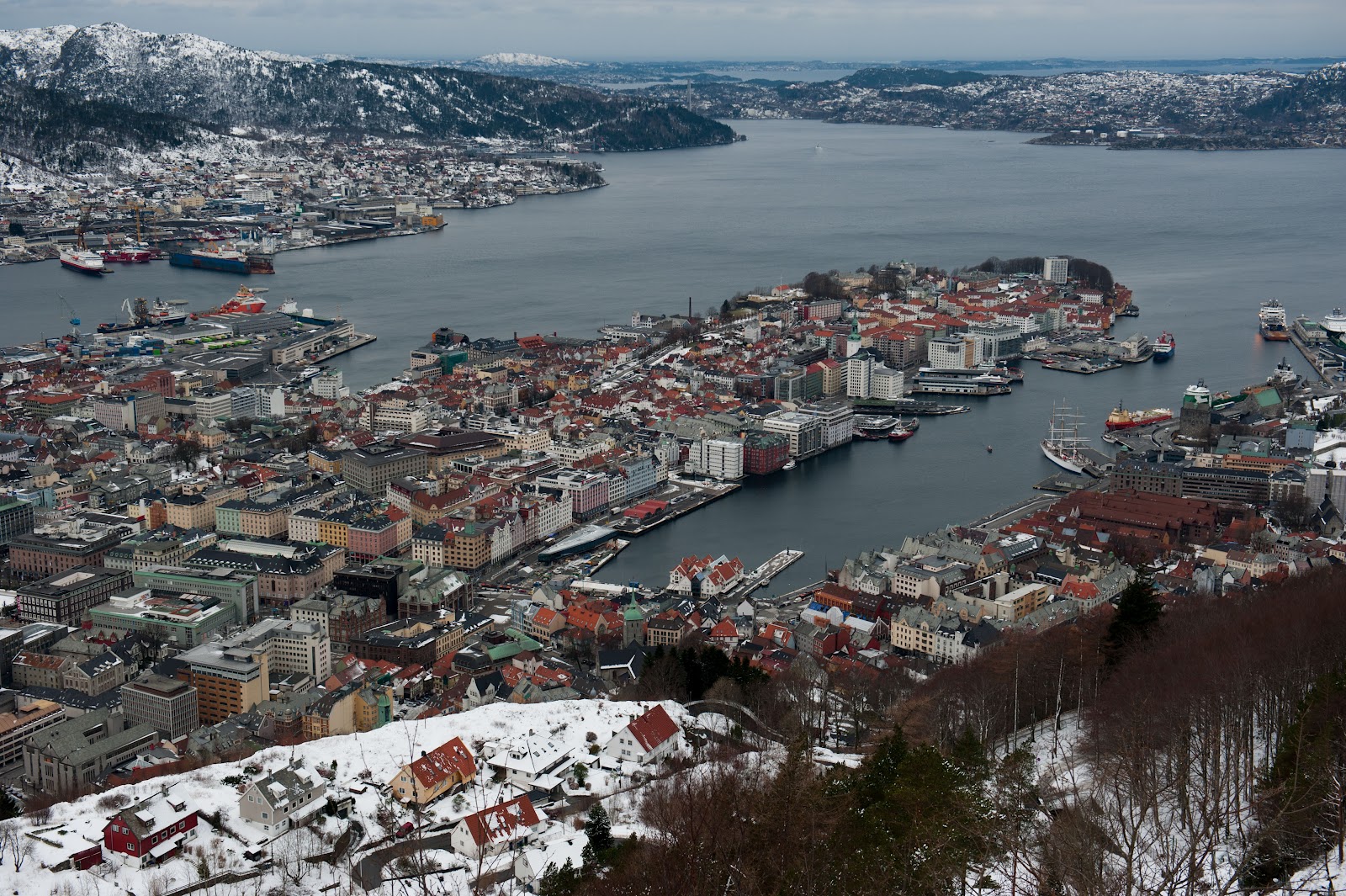
Bergen, Norway - booked independently
If I'm going to travel around North America in peak travel season, or I need to be in particular places at specific times, I do almost always book hotels in advance.  I also tend to book almost all of my European travel on this basis.  I probably over-research and over-plan at times, but my excuse for this is that I really enjoy travel planning.  I enjoy stitching together a complex itinerary, and figuring what I can see and do, and how I'm going to do it, and in Europe it is generally possible to rely on the timetable and schedules that are published.  A recent example of a trip put together in this way was my Scandinavian trip in February.  I spent two or three days in January deciding where I wanted to go and how long I wanted to spend doing it, then used a collection of different websites to book the entire trip. My booking strategy was to start by booking the 'hardest' bits first.  These were usually the most restricted bits, for example where I wanted to be on a particular boat, train or plane.  For me the most 'restricted' bit was the wish to travel along the Norwegian coast on one of the old Hurtigruten boats.  The next step was the flights and the long distance trains where there is some flexibility.  Step three was to figure out where to stay in places with limited accommodation - for example little towns where there weren't likely to be too many hotel rooms available.  The final stage was booking hotel rooms in big cities - where there was never going to be a shortage of accommodation, and the only real reason for booking ahead was to get a good room rate. I didn't get round to booking these until a couple of days before I travelled. 

If it's practical, this in definitely my preferred way to organise a trip!  Maybe one day I'll figure out how to make some money out of choreographing trips this way for other people.

Option 3. Choose to let someone else sort it

The third category of travel involve the trips where I either (i) enlist a specialist operator to tailor a trip to my specification - and am prepared to let them do the legwork and be paid for it! or (ii) book a pre-arranged trip. I tend to do these where I don't feel that I know the region I’m planning to go to well enough, where I can't figure out how to stitch together the itinerary I want or where I just don’t trust the information I’ve got.  When I think about these sort of approaches I tend to think about trips to the Indian subcontinent or to South America. 

Sri Lanka, UK organisation by Wildlife Worldwide, ground agents Baurs
We took this tailored itinerary approach for our Sri Lanka trip last year.  We found a specialist wildlife tour operator in the UK, and asked them to put together an itinerary.  In practise when you go down this route you are relying on the operator knowing more than you (which isn't always the case) and on the operators choice of a good local agent to sort stuff out on the ground and actually make the trip happen.  On our Sri Lanka trip I wasn't always convinced that the UK agent knew much more than we did, but they did choose a very good local agent.

One of the questions that I’m always left with for a trip like this is whether it’s better to use a UK agent as your main point of contact or if you should go directly to a local agent.  I can think of two recent trips where I’ve used UK agents who then used a local agent (Baurs in Sri Lanka and Blue Poppy in Bhutan), and one example where I used a local agent directly (Falkland Islands Holidays).  The upside of using a local agent directly is potentially getting more direct information about places to see and maybe being able to negotiate costs, the downside is that you won’t get things like ATOL protection or probably the ability to pay by instalments or by credit card. And, if the local agent doesn’t have a presence in the UK at all, sending money to them can involve an fascinating exploration of the international banking system.

A simpler (and sometimes cheaper) version of the tailored trip is one where you opt to join a pre-arranged trip with a number of other people.  One of the attractions of this sort of trip is that you are probably going to be looked after from dawn to dusk (and often later) each day.  This allows you, if you wish, to decommission your brain for the duration of the trip.  You get up when you are told, get on the bus when you are told, and eat your meals when you are told. If the trip is an escape from e.g. work pressures at home, this can be good.  On the flip side, I've found that after few days there seems to be a herd culture that develops within the group which appears to make decision making impossible.  I still have vivid memories of an afternoon in Kashgar in western China where our tour leader decided to give us an afternoon “at leisure” with the instruction that we should find our own way back to the hotel (a short walk we’d done with him several times) when we were ready.  This induced a level of panic amongst several of our fellow travellers reminiscent of your average flock of sheep.  Only a few days earlier the same individuals had joined the trip as confident, thinking travellers!

Option 4. Hand-holding required

The final category of trip are to those places where it just isn't possible to travel independently. This can be a consequence of geography (there really isn't any local infrastructure to book) or of politics (local rules designed to prevent independent travel).  I've done trips of both types.  The polar voyages (to the Antarctic, South Georgia or Svalbard) rely on travel groups being self-supporting, and short of chartering and provisioning your own boat and hiring your own guides you have no choice other than to join an organised trip (at least not at the budget levels I live at). 

Bhutan - UK organisation by Cox and Kings, ground agents Blue Poppy
Some countries also put lots of hurdles in place to ensure that they don't have independent travellers wandering around.  I retain a residual suspicion of places where this is the case.  In China (when we visited Xinjiang) I felt this was all about trying to control what visitors got to see and where they went, and it was clear that we were being monitored most of the time.  In Bhutan we also needed to travel with local guides, but I felt that this was for much more constructive reasons.  The government there have been trying to manage the growth of the tourist industry, and attempting to prevent the tourist over-run that happened in Nepalese as the tourist industry developed.  In these places you don't really have the choice of how you put a trip together - the paperwork and bureaucracy involved with trying to travel independently is likely to be so overwhelming that you really have no option but to sign up with an experience operator.

So what’s the best way to travel?

The answer is going to vary from place to place.  I’ve had great trips using all four models.  If I have the choice, I’ll always opt for independent travel that I’ve planned and booked myself.  There are some places, and times, that where this isn’t realistic and in these cases I’ll opt for one of the other approaches.   Any travel gives you the potential to see and explore new places and to meet new people.  In some cases travelling independently gives you options for exploring places in your own unique way.  In other cases you need the support of either tour operators or fellow travellers to get the most out of a new destination.


(This piece nearly took a dramatic turn for the worse, when my spellchecker decided that my title was supposed to be "Indecent Travel".   I'll save that post for the post-watershed blog)