Showing posts with label Wildlife. Show all posts

Yellow-breasted bunting - Mongolia

Image by Martin Vavřík, via Wikimedia Commons
On this blog I usually report on trips I have done - this post is a bit different, it's about a trip I'm hoping to make.

I recently came across a request from the Wildlife Science and Conservation Center of Mongolia looking for volunteers to carry out an initial survey to find out what's been happening to the yellow-breasted bunting. This was until relatively recently a common breeding bird in Mongolia, but over the last ten years has gone from being of  'least-concern', through several intermediate stages on the IUCN lists, to now being listed as being 'endangered'.  The staff at WSCC want to understand why this change has happened, and hopefully what can be done to at least halt the decline and preferably reverse it.

I'm hoping to take part in this survey in June this year, but to take part I need your support.

In addition to looking for yellow-breasted buntings I'm also planning to produce a photojournal and a series of limited edition mounted prints from the trip - if you support me you'll be able to get copies of the journal and/or the prints.

There is more information about the project - and about how you can help at  http://northsouthimages.co.uk/bunting/

Updated 14 May 2015:  The organisers have decided that they need to defer the survey until the 2016 breeding season. I certainly hope to be able to take part then, and any offers of support for the trip in June next year would be very much appreciated.

How Close?

 One of the really rewarding aspects of having my pictures on display at the Jam Factory over the last couple of months has been the chance to talk to lots of people about both the pictures and places where they were taken.

For a lot of people the highlights seem to have been the wildlife images; the puffins, the penguins and particularly the polar bears.  And the most common question about the polar bears - how close were you?

Close to the waters edge, Svalbard
The reality is that for all the pictures I've taken of polar bears, I was on boats of varying sizes and separated from the bears by at least 10 or 12 meters of water.  Polar bears are well known for their ability to swim long distances (they aren't called ursus maritimus without good reason), however they don't swim very fast and certainly not fast enough to out-swim a Zodiac.

The bear images, in my mind, fall into two groups. 

Some were taken from 'big boats'. In this context a 'big boat' is a 100m long expedition ship, and bear spotting involves seeing bears a long way away then stopping the ship at an ice edge and hoping the bears will come close.  The bears natural curiosity, and their constant search for food, means that they will move long distances to investigate. 

This family came up close to the expedition ship Ioffe, Northwest Passage, Canada

A ship, particularly if it's quiet, deserves closer scrutiny.  In a number of cases, I can remember seeing bears a long way off in the distance, and just waiting until they came within a few metres of the ship, sometimes even standing up to get a good look at the visitors. In this situation, the visiting ship is changing the bears behaviour, but the key is leaving the bear in control, he or she is making the decision to come closer to the visitors.
Getting a closer look at the expedition ship Vavilov, Svalbard
The other group of images, often the more intimate ones, are taken at bears-eye level from Zodiacs.  These are very manoeuvrable inflatable boats with outboard motors, which can move in towards the bears to get a closer look at what they are doing.  The balance here is getting close enough for good photographs, but not so close that the bears behaviour is changed.  My favourite set of bear images were taken from a Zodiac, probably no more than 15 metres from the bears who were in this case completely absorbed in feeding on a old whale carcass washed up into a bay in Svalbard. 

Walk the Spine, Svalbard
Concentrating on Lunch, Svalbard
In some cases, particularly with young bears, they will get curious about the visitors in the rubber boats too, and will try and get closer so that they can get a good look. The sensible thing to do at this point is to slowly back away from the bears, but this can provide some great photo opportunities.

Looking at the Zodiacs, Svalbard
You can have a closer look at some of these images at the Jam Factory in Oxford, until 13th January 2014 and on the North South Images website at any time (www.northsouthimages.co.uk


Big Garden Bird Watch - early

Most years we do the RSPB Big Garden Bird Watch (this year it's 30th & 31st January), but this morning turned into a rehearsal.  An hour peering out of the windows produced a huge amount of bird life, no doubt some of it provoked by the fat-ball bribes we've been distributing around the garden since the cold weather started.

Today's list was 2 chaffinches, 2 redcaps, 2 jackdaws, 5 house sparrows, 3 long tailed tits, 3 goldfinches, 4 blackbirds and half-a-dozen starlings plus a couple wood pigeons, a wren, a dunnock, a great tit and a collared dove.

There's nothing particularly spectacular in the list, but it was good to see some goldfinches back (no idea where they went in the snow), and it's been a while since we've seen long-tailed tits in the garden.

We'll be doing the BGBW next weekend - but it probably won't result in nearly such a good haul.

Watching The Albatross

I'm not sure I'd go quite as far as Robert Cushman Murphy who in late 1912, asserted that he now belonged to "a higher cult of mortals" because "he had seen the albatross", but I do consider myself to be lucky to have seen a variety of albatross over the last couple of years.

My first sighting of the albatross was from MS Fram heading south from Ushuaia towards the South Shetland Islands in November 2007 - on that trip I saw four different species (Wandering, Black-browed, Sooty and Grey-headed). However, I saw all of these at a distance and, truth be told, I was pretty reliant on the accompanying naturalists to confirm which I was seeing.

Those first sightings were enough to encourage me to head back down to the Falkland Islands earlier this year so I could get a look at one of these species at close quarters.

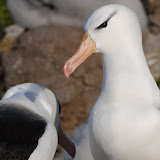
I spent a few days staying at the Neck on Saunders Island in the northwest corner of the Falklands.  The attractions on Saunders include colonies of gentoo, magellanic, rockhopper and king penguins, as well as Johnny Rooks (striated caracaras), king and rock cormorants - but the real draw is the huge breeding colony of black-browed albatross. These awesome birds nest on mud-turrets on a steep hillside facing northwards towards South America - and I was able to sit close to the colony (which they share with both rockhoppers and cormorants) watching the adult albatross sweep dramatically back in from the sea. They stumble through a landing process, most charitably described as ungainly, before going through their welcoming rituals with their partners and then turning their full attention to childcare. The beak-tapping ritual reinforces the bond between the adults - but the real magic is the delicacy of touch demonstrated after feeding when the adult's huge curved beak is used to pick away left-overs from around the chick's head.

I was at the colony in February when the down-covered chicks are not yet quite ready to fledge, but are almost the same size as the adults. The chicks spend much of the day sitting balanced high on their mud look-out posts waiting for the adults to return with another load of freshly caught squid. One of my strongest recollections is walking along the tracks high above the colony aware that many pairs of chick eyes were following me - and if I dared cross the invisible line that the chicks considered to be the safe distance they would very vocally encourage me to take a few steps back up the hill.

A few of the photographs I took around the colony are linked below.


Saunders Albatross February 2009

I spent several days on Saunders Island, and was privileged to be able to spend a lot of hours just watching the comings and goings at the colony, particularly watching the chicks waiting for the adults to return from their long-range foraging trips. This makes the activities of the Albatross Task Force even more important in my mind and I'll be encouraging folks I know who are interested in bird-life to help support the project. We (collectively) need to do everything we can to help protect these magnificent birds as they search for food across the Southern Ocean - I'm trying to figure out how and where I can get to see other albatross up close, but in the meantime I'll continue supporting the ATF.

Boston & Montreal July 2009

Spent two really good weeks in the US and Canada. First week at the Sakai Conference in Boston, and the second at the IMS GLC Quarterly Meeting in Montreal. These were both really good meetings and were in two of the most european cities in North America (and that's a compliment).

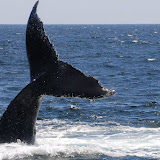
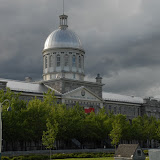
Did manage to find a little bit of time to take a few pictures in/around Boston and Montreal, and went whale-watching during the weekend between the conferences.
Boston July 2009
Whales July 2009
Montreal July 2009