Showing posts with label Landmark Trips. Show all posts

North Atlantic Odyssey May 2017

Back in the 19th Century the boats used to set out from the northeast coast of Scotland in search of whales.  These boats used to head up to Shetland and then strike north towards the Greenland coast in search of right whales and humpback whales.

Now-a-days there are still occasionally boats that set out from the northeast coast of Scotland in search of whales.  And as in the past they head up to Shetland and then strike north towards Greenland in search of whales.  There are differences.  The whales being sought are mostly orca and fin and minke whales, and the searchers are armed with big lenses rather than harpoons.  I’m guessing that the boats are rather more comfortable than would have been in the case in the 19th Century. 

Ortelius in Svalbard

I was lucky enough to be on the Ortelius when it left Aberdeen recently heading northwards in search of whales and hoping to be able to land on Jan Mayen island off the Greenland coast, before winding up in Svalbard.

If I’d done a bit a due diligence, I might have found out that in recent years this trip has on occasion suffered from wild sea conditions, seen very few whales and failed to be able to make landings in Jan Mayen.  Sometimes all three.  However when I found that this was a way to visit Jan Mayen, I didn’t do any such due diligence, I just paid my money and assumed that it would all work out right!

It’s nice that such naivety does occasionally pay off. :-)

We left Aberdeen on a calm Monday evening and headed slowly northwards, the Ortelius always heads slowly - top speed is about 10 knots.  By breakfast time the next morning we could see Fair Isle ahead of us, and by 09:30 we were being zodiac’ed ashore into North Haven.  It was a bit odd being 25 miles from the house on Shetland but not visiting there, it was however delightful to be back on Fair Isle, and I think I can honestly say it’s the first time I’ve arrived on Fair Isle not feeling seasick.  The Ortelius may be rather smaller than the Northlink boats that ply between Aberdeen and Shetland, but it is a lot bigger (and more stable) than the Good Shepherd that carries people between Fair Isle and the Shetland mainland.   On Fair Isle both the human and puffin population turned out in force to welcome us, and we got some glorious summer weather too.  

Shetland Puffins
Typical Fair Isle weather

Having had a little taste of Shetland, we were zodiac’ed back to the Ortelius and the serious business of heading north could start.   Jan Mayen was our next planned landfall some 1300 km away.

If the weather is wild this can be a pretty unforgiving area of sea - but if you get lucky it can be smooth and whales, while never easy to spot, get significantly easier to see.   This is particularly true as you get further north and the whales blows get clearer as the air temperature falls.  It’s difficult to not think ‘There she blows’ when you see a blume in the distance, and hearing someone excitedly shout this out loud is still one on of my highlights from the early part of the trip.  One of the bonuses of the slow moving Ortelius is it’s nimbleness in turning when a whale is spotted, and we had several episodes when we were able to get really clear looks at a range of different whales species during the two days it took to get to Jan Mayen.  

Northern Bottlenose Whales
Minke Whales

During these two days we saw big pods of long-finned pilot whales, lots of northern bottlenose whales (including a pair that dived right under the bow of the ship), fin whales and minke whales and orca too.  Cold flat seas are perfect for whale spotting, but when you’re seeing whales several kilometres away it can be pretty challenging to identify them, but I’d think that is something to list under ‘good problems to have’. 

As we had been heading north the expedition crew had been keeping us updated on the Jan Mayen weather.  We knew that we’d had remarkably calm weather south of Jan Mayen, but Jan Mayen is (in meteorological terms, at least) a law unto itself.   The big feature of Jan Mayen is a very large active volcano - Beerenberg.  This volcano rises almost 2300 metres above level, is flanked by a series of glaciers and completely dominates the north end of Jan Mayen - the sheer scale of the mountain and it glacier collection make is a perfect breeding ground for catabatic  winds that can make landing on the few beaches very hazardous. It is claimed that the top of Beerenberg is only clear of cloud on 3 days each year.  It’s my sad duty to confirm that the day I visited wasn’t one of those days.  

Jan Mayen - weather/communication station 
Kvalrossbukta, Jan Mayen

We able to land at two sites on the island, at Batvika on the southern side and at Kvalrossbukta. on the northern side.  Although both landings were completed successfully we did get a brief glimpse of how fast the weather can change, as a rogue wave successfully swamped one of the zodiacs (finally dispelling any ambiguity in what is meant by a wet landing). 

After the second landing we cruised along the mouth of Engelskbukta (English Bay) hoping that we might get a glimpse of top of Beerenberg, but that is going to have to wait for another visit, before again turning north in search of the sea ice off the Greenland coast.  It’s about another 1000 km from Jan Mayen to Longyearbyen in Svalbard, but we opted not to follow a direct route. Instead we continued north in search of ice before turning east to get to Svalbard. 

It’s worth pointing out that this far North at this time of year there is 24 hour daylight - so we were watching for wildlife throughout the 24 hours each day. This meant that the ‘day’ would start with a tannoy message “Good morning, good morning, there are orca directly ahead of the ship”, and just as you were contemplating getting a bit of shut-eye in the evening -  “We think we’ve just spotted polar bears on an ice floe directly ahead”.  Both messages pretty much guaranteed to result in a frantic charge to the ships forward viewing points - and both happened on the same day.

Orca
Bears on Ice

As we headed further north and west we found much more sea ice - but not yet any well-defined ice edge, which is where we might have hoped to find a variety of sea mammals - as the ice became a bit more joined up we found quite a lot of hooded seals (a meal-time favourite of the polar bears) and recent polar bear tracks, but no further sightings of polar bears.

Hooded Seal heading for safety
Bear Tracks

At this point the calendar started to catch-up with us and we needed to head eastwards to get to our dock-date in Svalbard - and as we headed east the weather decided to give us just a little flavour of how things might have been during the rest of the voyage.  An afternoon and evening of rolling through the waves was a reminder that the seas in this part of world aren’t always like mill-ponds.

Stormy Weather

Once through the weather, we again got to flat seas, this time with blue skies too.  Our first Svalbard landing was Prins Karls Forland (an island on the western edge of the Svalbard archipelago).   The objective here was a well known walrus haul-out at Poolepynten where we were able to get up close to a number of walrus.  I’ve visited a couple of walrus haul-outs in this part of the world before and been pretty underwhelmed.  This visit was different - we had a number of curious walrus on the water edge alongside us and they were almost as interested in us as we were in them.  The fact that they were in the water (their element) clearly gave them the confidence to come really close to us - and to stay there too.

Walrus at Poolepynten

We also got a glimpse of the goretex-hooded tourist in the distance - these shy mammals (a little like their penguin cousins in the far south) huddle together for warmth on the ice-shelf.

Tourists

The final treat on the voyage was a brief glimpse of blue whales (the biggest of the whales) around the mouth of the Isfjorden on Svalbard.  And a reminder that some people do still sail these seas in boats that are a bit closer to the ones that the whalers used.
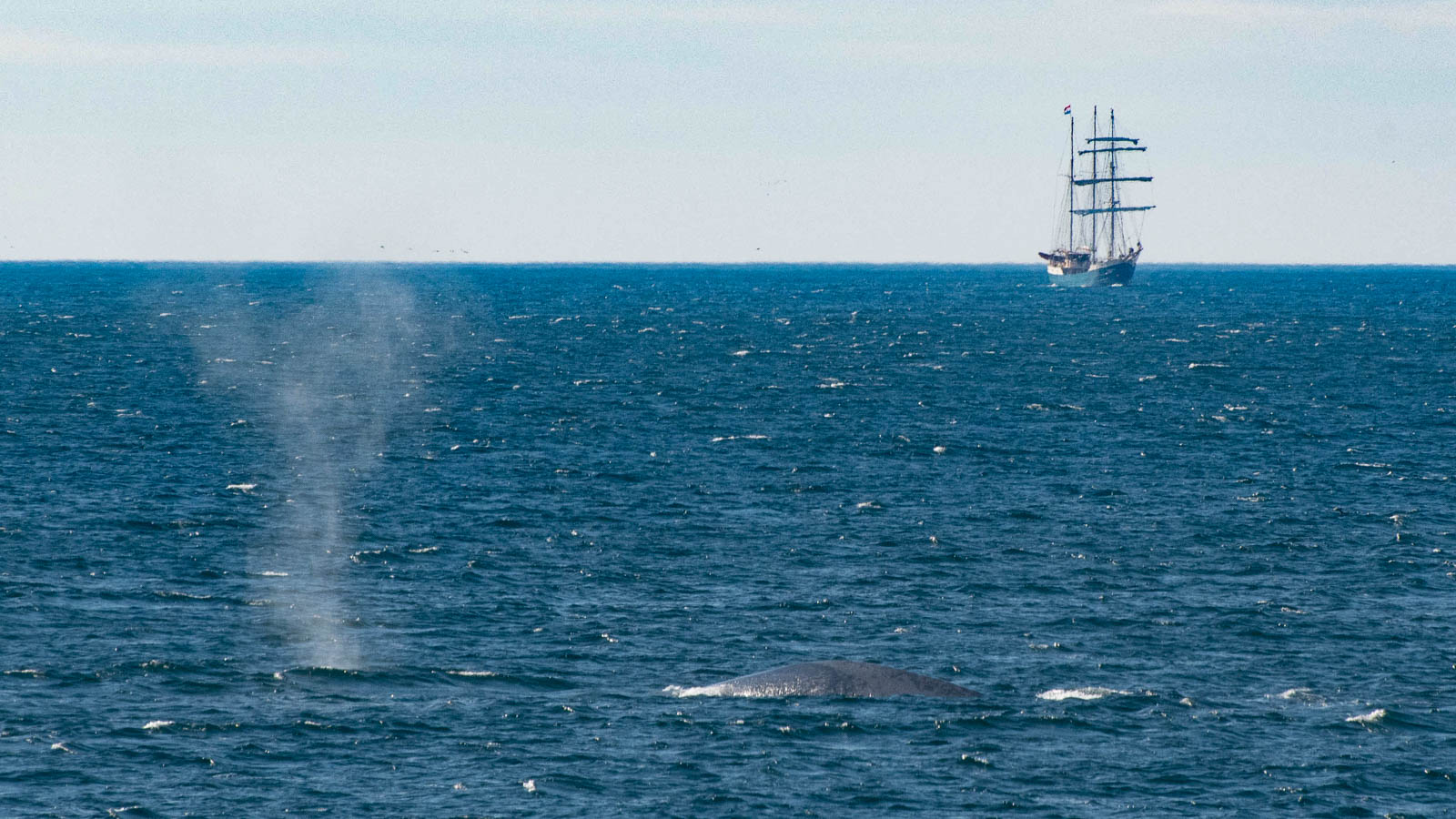
Blue Whale at the mouth of Isfjorden, Svalbard - and a glimpse of more traditional travel

The voyage really did live up to my hopes.  My first objective was to get ashore at Jan Mayen and to learn more about it.  Yup. My second objective was to see a variety of north Atlantic whales.  Yup. Got that.  And my third objective was to see polar bears again. Yes, again.

And the bonus - I think I’m now going to have to promote walrus in my standard arctic talk - they’ve much more interesting than I’d given them credit for.  Job done.

And the disappointment.  A few lucky people who were in the right place at the right time got a good look at a Ross’s gull (a rare gull, only found in the really far North).  I wasn’t one of them.  Still, got to keep something for the next trip to the high Arctic.

In all a thoroughly entertaining trip - a fantastic way to escape the pre-election news and a good way to met some lovely like-minded people.  I'm sure Oceanwide will be running a very similar trip next May too, but I'm afraid I might have used up all the weather luck.

Scandinavia February 2012

I've finally had the chance to work through the collection of photographs I took on my Scandinavian tour in February 2012.

There were four phases to the tour.

1.  Following the railways along the 60N line - starting in Stockholm (59.3N), going west to Oslo(59.9N) and then to Bergen (60.4N).  Flickr.

2. Going North (and East) along the Norwegian coast on the Hurtigruten ship MS Lofoten, from Bergen to Kirkenes (70N, 30E) then back South to Svolvaer in the Lofoten Islands. Flickr

3. Exploring the Lofoten Islands (based in Svolvaer) Flickr

4. Exploring the Faroe Islands (based in Torshavn) Flickr

South Georgia, December 2011


King Penguins, St Andrews Bay
South Georgia has been on my mind for a long time.   I visited the Antarctic Peninsula in 2007 and the Falkland Islands 18 months later – but South Georgia was the missing bit.  I talked with lots of polar enthusiasts who had ‘done’ South Georgia, and their comments were almost always along the lines of ‘fantastic place, shame we had so few days there’.  Most of these folks had done the classic Antarctic ‘long’ itinerary from Ushuaia or Punta Arenas – spending a few days in the Falklands, a few days in South Georgia and a few days on the Peninsula and quite a lot of days at sea going between the various points.

From everything I’d heard there was a huge amount to do and see on South Georgia and a few days was never going to do it justice, particularly give the unreliability of the weather.  It was clear to me  that I wanted to find a trip that offered more than just a few days – eventually step forward Steppes Travel, who I met at Wild Photos 2010 in London, who were able to find me a trip that focussed on South Georgia and, better yet, did so starting from Stanley in the Falklands which both reduced the sea time and gave me the perfect excuse to spend time in the Falklands before-hand.

Plancius, Stanley Harbour, Falkland Islands
The trip, 14 days starting and finishing in Stanley, was run by Oceanwide Expeditions on a converted Dutch hydrographic vessel, now called Plancius, on this trip with 95 passengers on board.  The crossing from the Falklands is about 780 nautical miles and even in good weather this does take around 72 hours.  This fact is rather glossed over in the pre-trip information which talks about two days at sea – and there was certainly some restlessness amongst some of the passengers who I suspect thought they might be seeing mountains and glaciers when they drew back the curtains on the third morning.
 
King Haakon Bay under clouds
We did finally see South Georgia late on the third day – almost exactly 72 hours after we steamed through The Narrows at Stanley Harbour.  Our first sight of South Georgia (King Haakon Bay on the south side of the island) wasn’t quite the picture book view the guide books might have suggested – we had low cloud and a decidedly unpleasant wind which meant that only ‘essential’ zodiac work could be attempted.  In the context of this trip, the ‘essential’ zodiac work was off-loading a large group of ski-mountaineers who were planning to attempt to cross South Georgia (the Shackleton Challenge) emulating Ernest Shackleton.   The rest of us we were torn between the desire to be off the boat looking for wildlife and the relief that we would be eating hot food and sleeping in warm berths rather than fighting the elements and sleeping in wet wind-swept tents.

Orca in South Georgia
Our first exposure to South Georgia’s wildlife came very early the following morning but wasn’t the expected fur seals or king penguins – it was the call of ‘whale’ over the ships intercom.  We found a pod of orca hunting in the waters off the north coast of South Georgia – the whales were between us and the shoreline, with the sun behind us. The mountains provided a back-drop, and the cold air ensured that the whales ‘blows’ were really clear to see.  The trip organisers had certainly got all the choreography just right.

Over the next seven days we had 12 successful off-ship excursions – and probably lost four other excursions to the weather.  These excursions were all on the north side of the island – this is the more sheltered side of the islands and also where almost all the wildlife is to be found.   Sheltered is a relative term in this part of the world – some of the bays are wide open and the winds can whip across very fast indeed.  The ‘nightmare scenario’ for all the expedition boats is putting 100 people ashore in calm conditions and then being caught out by rapidly changing weather.  On a couple of occasions we needed curtail landings to ensure that we didn’t get caught, and on one other occasion the expedition staff needed to resort to pulling the zodiacs onto the beach stern first to ensure that they were going to be stable enough to allow passengers to get back on.  Over the course of the week every one got to fully appreciate the term ‘wet-landing’.

I’m going to pick out  four of the sites we visited during the trip – three involved using zodiacs to get ashore, the fourth (Drygalski Fjord) was a ship-based cruise along one of the deep fjords at the southern tip of the island.  There will be more about all the locations I visited on South Georgia in the Place Notes site that I’m currently developing.

Our first big penguin colony landing was at Salisbury Plain and it introduced us to lots of aspects of being ashore in South Georgia.  We had a wet landing, aggressive fur seals, wild changing weather and lots of king penguins.  Salisbury Plain (named because of supposed similarity to central Wiltshire – although I couldn’t see it myself) is a big wide sweeping beach with a hill behind it and fresh water running down into the bay.  This is ideal terrain for seal and penguin colonies – but very exposed to the elements.   When we landed the weather was still and calm, by the time we’d been on the ground for two hours the ship was disappearing in low cloud and the dry sunny weather had degenerated into horizontal rain.  We did get to learn about the various techniques for evading fur seal (it involves a lot of growling back), and we also got to know the king penguins and their chicks.  December is a really good time to see lots of king penguins – at this time of year (early summer) all the penguins are on the beaches.  Last year’s chicks are going through their final moults, the mature adults are either moulting or are getting into their courtship routines or are sitting on eggs.  The one things the Kings aren’t doing, is spending a lot of time out at sea – so the beaches and colonies are full to bursting.


The landing at St Andrews Bay was, for me, the highlight of the time on South Georgia.  We needed two attempts to get ashore here – the first attempt was scuppered by high winds.  No one was saying this at the time, but the aborted landing was a good thing.  If we had got ashore on that day when the visibility was poor we wouldn’t have seen the colony in its real glory.  As with the Salisbury Plain landing, we went ashore quite a long way from the main colony site, in this case at the north end of the beach.  
We were then led inland up towards an outlook point which looked down on the colony – stepping up onto the outlook point and seeing upwards of 400,000 penguins in front of me is something that I’m not going to forget anytime soon.  One of the reasons for coming all the way to South Georgia was to see huge single species colonies like this.   I’ve seen David Attenborough talking about these sites on numerous television programmes over the years, I knew I was going to be seeing a lot of penguins, but somehow really seeing it was still a shock to the system.  

The Drygalski Fjord is the biggest inlet at the south tip of South Georgia – and it’s both big enough and deep enough to allow a reasonable sized ship to cruise in, and to go right up to the end face of the Risting glacier at the end of the fjord.  So that’s what we did. 

Our final landing in South Georgia was at Grytviken and is the one place where it’s possible to wander round an old whaling station – and to send postcards and buy souvenirs.  There were at one time seven active whaling stations dotted along the north coast of South Georgia.  Some of those have been completely cleared away, others (like Stromness and Prince Olav Harbour) haven’t been cleared but have been declared out of bounds (flying debris and asbestos being the main risks).  Grytviken has been made safe, so it is possible to wander round looking at the remaining buildings and some of the old, abandoned whaling boats – the most shocking aspect is the sheer scale of the machinery.

It’s difficult, from the perspective of the 21st Century, not to see this as anything other a monstrously barbaric industry, and to be thankful that the industry became uneconomic before the whale populations had been completely wiped out.  It seemed that there was something symbolic about our first real wildlife sighting of the trip being orca, and the final landing was at a disused whaling station.  The reminder that a species can recover from incredibly intensive hunting comes from the Antarctic fur seals that now occupy every beach in South Georgia.  These animals were really heavily targeted in the early 20th Century for their amazing soft thick pelts.  I found how soft they were by stroking a sample in the museum in Grytviken, I certainly wasn’t about to try and stroke a seal on the beach.  I don’t know if these animals were any more tolerant of man before we tried to make them extinct, however these days fur seals are extremely aggressive and will have no hesitation in coming after a Goretex-clad tourist. Their bite probable wouldn’t actually kill you, but I gather that their dental hygiene leaves something to be desired and disinfecting the wound probably wouldn’t be a pleasant process.  Grytviken and its museum are fascinating places – and my only regret is that we didn’t get more time to both wander the old station and to do the museum justice.

One of the things I learnt more about – and saw the impact of – was global warming.  Like everywhere else South Georgia is getting warmer.  The most visible impact of this is that almost all the glaciers are receding, which has the potential to completely change the environment on South Georgia.  Until very recently almost all the glaciers did reach all the way to the sea, now quite lot of them stop short of the coast.  Even just comparing guide book images to what’s visible on the ground highlights how rapidly this change is happen.  This change doesn’t make a huge direct difference to a lot of the species on the island in the short term, but it does to the rats!  South Georgia has had rats since people first got there (and got ship-wrecked there) – and where there are rats they have a really major impact on the ground nesting birds, and given the lack of trees, almost all the birds are ground nesting!  At the moment the areas that the rats have been able to get to are limited by the glaciers, but if (or when) the glaciers recede from the coast the rats will have the run of the island and would almost certainly have a catastrophic impact on the bird populations.  At the moment there is a pilot rat eradication programme underway on South Georgia with the aim of completely clearing the rat population while it’s still constrained to limited areas.

Shackleton survived the Shackleton Challenge, but he
died on his next visit to South Georgia in 1922.
The other impact of the global warming is on people, specifically the group attempting the Shackleton Challenge I mentioned at the top of the article.  When Shackleton did the ‘Shackleton Challenge’ in 1916 (he probably didn’t call it that, and he almost certainly considered the 800 miles in an open boat to get from Elephant Island as the greater challenge) he had the benefit of much colder conditions that climbers get now on the challenge.  Shackleton, Worsley and Crean were able to scramble up solid (and stable) ice – and to toboggan down a huge ice slide on their way into Stromness.  Today challengers face a much tougher challenge – much of the ice has gone so there a lot more rock to contend with, and where there is ice it is very heavily crevassed and therefore much more difficult to cross.  Of the 24 challengers on the trip with me, only 5 (all with really impressive mountaineering CVs) successfully completed the challenge the other 19 came out via an escape route.  I wouldn’t go as far as saying Shackleton had it easy, but global warming has certainly made the challenge a very different one these days.

I started by talking about having had this trip in mind for a long time – did it live up to my hopes and expectations?  The answer is a pretty emphatic yes.   I think we were pretty lucky with the weather – we got 12 good excursions in our week around South Georgia, and we also got to see how bleak it can be even in the southern summer.   I’m really pleased with some of the pictures I took, although I’m still working through some of them, and I’m really delighted to have seen the big colonies that South Georgia has to offer.  The sight of so many animals on the beaches is one that is very difficult to get out of my head.  Would I have wanted more time on South Georgia, again yes.  If anyone is planning a three week trip to South Georgia coming out of Stanley, sign me up.

There are two quotes floating around in the back of my head that relate to the trip.  One of the Frozen Planet team assured me that I’d really like South Georgia, “It’s like the Peninsula with the volume turned up”.  He was right.  The other quote was from of the expedition staff.   “If I had two weeks to live, I’d spend one of them on South Georgia, and the other one getting there”.  I think he was probably right too. 

UPDATED 18/01/2012: More pictures are now online on Picasa and on Flickr

Falkland Islands, November 2011

I don't have a good track record on going back to places - at the end of lots of trips I can be heard saying "I must go back there".  The reality is that the attraction of things and places I haven't seen often, even usually, over-rides the lure of the familiar.  The other problem is that if a holiday is really good, there is the risk (perhaps more percieved rather than real) that the repeat visit won't be as good and the memories of the first perfect trip will some how be sullied.

In early 2009 I spent an excellent two weeks in the Falklands, and this month I've just spent another fantastic two weeks island hopping in the Falkland Islands. In some ways this was a repeat of the 2009 trip, the key differences being that I opted to come south via Chile rather than using the MoD air-bridge from Brize Norton, and I've come much earlier in the southern hemisphere summer.  The birds are either sitting on eggs or are tending to small chicks rather than contempating their autumn migrations.

As with the last trip I opted to spend longer periods on a few islands, rather than trying to visit lots of islands for small periods of time.  I've spent time at Darwin and Stanley, both on the East Falkland mainland at the start and end of the trip respectively.  It is possible to fly out to the islands immediately on arrival off the international flights, but it does require significant faith in the punctuality of the incoming flight (and in 2009 I was over six hours late).  Most people spend a night or two within driving range of the main airport at Mount Pleasant at both beginning and end of the trip. Both Darwin and Stanley have some attractions and interest for both wildlife and history tourists, but for me the real Falklands is out in the islands amongst the wildlife.  I had long blocks of time on two similar but very different islands.  Sea Lion and Carcass Islands are similar in that they are small (i.e. walkable) islands with very good accommodation (including excellent cooking).  They are different in that they are at opposite corners of the of the islands (one in the south east, the other in the north west), and in that Sea Lion is flat while Carcass is mostly rocky and hilly (with just enough flat space to land a FIGAS plane - although the owner of Carcass assures me that the RAF have checked out the ground around the airstrip to confirm that it would be possible, in emergency, to land a Hercules).

On Sea Lion, the stars of the show this time really had to be the orcas, who regularly put in appearances spectacularly close to shore, with a close second being the ridiculously cute gentoo penguin chicks.  This, of course, in addition to the kelp and dolphin gulls, the rock and imperial cormorants and the huge number of snipe which lurk deep in the undergrowth where you can only see them if they move or decide to start announcing their presence.


On Carcass there were a lot of the same birds as on Sea Lion, however the Johnny Rooks were very evident, around the settlement at least partly because of Roldan's - the chef - habit of feeding them on a regular basis. I watched over 30 Johnny Rooks follow him down to the beach one afternoon - looking very much like the Falkland Islands answer to the Pied Piper.  It was particularly good to see a pair of magnificant Crested Caracaras roughing it alongside their distinctly more rogue-ish cousins the Johnny Rooks (Striated Caracaras).  However, my favourite birds on Carcass were probably the long-tailed meadowlarks and the Cobb's wrens, both very visible, and with a litle bit of patience ready to be photographed.

From Stanley, I now join the Plancius for a two week trip to see South Georgia. The boat is sitting in bright sushine in Stanley Harbour as I type, busily off-loading the current passengers to connect with the regular weekly LAN Chile flight.

Even as I sit contemplating South Georgia, I can't help thinking about when I'll be able to get back to the Falklands and what I'd want to do on that trip.  Maybe February?


Logistics and thanks.  I flew into the Falklands with LAN Chile via Santiago, and my local arrangements were sorted by Arlette Bloomfield at Falkland Island Holdays.  In Darwin I stayed with Graham and Fiona Didlick at Darwin House.  On Sea Lion Island I stayed at the Sea Lion Lodge with Jenny Luxton, on Carcass stayed with Lorraine and Rob McGill, and finally I stayed with Arlette Betts at Lafone House in Stanley.  The UK end of the arrangements were made via Sue Grimwood at Steppes Travel.  Thanks to every one who's looked after me over the last couple of weeks, without exception the accommodation and hospitality has been wonderful - and the food, in terms of both quality and quantity just amazing.

(Pictures eventually added in mid-January...)

UPDATED 18/01/2012: More pictures are now online on Picasa and Flickr

Sri Lanka October 2011


I can’t explain why it’s taken quite so long to get round to visiting Sri Lanka.  We first visited India over 20 years ago – and I’ve been back there several times for both work and vacation over the years.  I added Pakistan to my sub-continent collection a long time ago too, and more recently we added both Nepal and Bhutan to the list.  But, somehow we managed to keep leaving out Sri Lanka.

It’s not that we were deliberately ignoring the country – we’ve been to England Sri Lanka Test matches, and just after the 2004 Indian Ocean tsunami we talked about visiting in response to the pleas for tourists to come back to the country.  Somehow other plans and destinations kept getting in the way.

We didn’t even plan to go to Sri Lanka this year – we were on the point of booking a trip to Japan, when the Tohoku earthquake and tsunami struck – but after a bit of thrashing around we decided that Sri Lanka was going give us some decent wildlife watching with a bit of culture thrown in.

We based our itinerary on a 10 day trip that WildlifeWorldwide offer, but decided that we were just going to stretch it a bit – so we added in an extra night in the Cultural Triangle (more culture), an extra night in the Hill Country (more cool), an extra night in the national parks (more wildlife) and an extra night on the coast (more luxury).

The Culture Bit
Rock Temple, Dambulla
Sri Lanka has an impressive inventory of UNESCO World Heritage sites – we clocked up six of these on our trip (Anuradhupura, Polonnaruwa, Sigiriya, Dambulla and Sri Dalada Maligawa in Kandy, in the Cultural Triangle) in the middle of the island, plus Galle down on the south coast).  The first three, although impressive in some ways, didn’t really provide either much sense of inspiration or excitement.  I think this is partly because there were very few other visitors, either from Sri Lanka or overseas, around at these sites – and they really felt a bit unused and unloved.  This changed as we got to the sites in the southern part of the Cultural Triangle.  There was a definite buzz to Dambulla, and a short but hot climb past the new Japanese-funded Golden Temple took us up and into the old Rock Temple complex.  This was the first site in Sri Lanka that both intrigued and impressed.  A huge temple complex with hundreds of made-to-fit statues tucked into an over-hanging cleft in a cliff is a bit mind-blowing when you read about it – and still more mind-blowing when you get to wander round.  The final cultural episode was to visit the Temple of the Tooth in Kandy.  Our guide recommended that rather than visit this late in the day (as our itinerary suggested) we would have a much better visit early in the day.  I can’t comment on what we would have seen in the afternoon, but we managed (by good co-ordination I’m sure) to get into the Temple just in time for the morning puja, and were expertly navigated, by a local guide, around the various parts of Temple despite the huge number of locals visiting on a Saturday morning.  Huge crowds of people, in a confined space, can be a bit daunting – these crowds were so cheerful and good spirited that the experience was thoroughly uplifting.

The Hill Country Bit
Gregory Lake, Nuwara Eliya
After the heat and the culture we headed a little bit south and up into the Hill Country in the middle of Sri Lanka.  This is the area where you turn off the air-conditioning in the van, where the hotel rooms have extra blankets and electric fires, where the locals wear woolly hats and where your guide asks if you have warm clothes with you.   Our thick high-latitude blood didn’t really register the climate as being cold, but it was nice to be able to wander round in shirt sleeves without dripping sweat, and to get a decent night’s sleep without the background roar of an air-conditioning unit.  We were based in at The Grand Hotel in Nuwara Eliya for a couple of nights, and had a completely untimetabled day.  This gave us the space to wander in the local parks, to talk with the locals and generally just relax.  I think this is the first time we’ve decided to add in a ‘do-nothing’ day on a trip like this, and we’ll certainly do it again.

The Wildlife Bit
Leopard, Yala National Park
After getting de-stressed in the Hills (after all, several days of full-on culture do need a bit of recovery time) we dropped down into the low-lying southern coastal plains to spend four days in three of Sri Lanka’s showcase National Parks – Yala, Bundala and Udawalawe.  These parks were everything we’d hoped for.  They were relatively quiet (particularly Bundala and Udawalawe) and the wildlife did its stuff.  We got positively blasé about the number of kingfishers and bee-eaters that were on display everywhere, and got wonderful opportunities to watch lots of waders particularly in Bundala.   The highlight of the first day in Yala was the large number of elephants around – the elephants are of course always there but we got lucky in being in the right places at the right time.  The star turn that didn’t show up on the first day were the leopards.  Our guides were clearly making leopard spotting the top priority on the second day – and we spent a lot of time touring the areas that the leopards frequent.  We had one fleeting glimpse of a leopard in mid-morning as it headed into the deep undergrowth beside one of the huge tanks (reservoirs) that are at the heart of the public bit of Yala – I was fortunate to swing my binoculars into exactly the right place as the guide shouted ‘leopard’ and got an amazing view of a leopards back beautifully lit by the sun.  Our next view of a leopard was many hours later. One of our guides got a tip-off that a leopard had been seen close to where we had seen the one in the morning, the down-side was that at this point we were about as far from this tank as it was possible to be in Yala.  As we hurtled at breakneck (not literally) speed across the rutted park tracks we spotted other land-rovers heading in the same direction – news of a leopard spreads fast!  We were rewarded by seeing not just one leopard gradually tracking his way round the tank, but encountering another leopard in the faded evening light.  This is what wildlife watching is about.

Days three and four were in Bundala and Udawalawe.  Bundala is a coastal park – which is Wader Central – and a really important wintering place for migrants.  The migrants were just starting to appear in small numbers – our guide kept saying that we should here a little bit later in the year.  For me the highlights were the terns (particularly the Caspian tern, which is huge) and the “tickny”, which our guide got very excited about.  It took us ages to realise he was saying ‘thick-knee’ – the other name for the stone curlew!

Udawalawe is back inland, and was created about 40 years around a new reservoir to ensure that reservoir water feeds couldn’t be disrupted by development activity.  It is often described as being Sri Lanka's answer to the African savannah - it offers lots of elephants plus huge numbers of birds. Early October is the end of the dry season and the birds and animal are all concentrated around the waterholes and the hugely shrunken main lakes. Once the rains get started the water levels in the lake rise by several meters. It’s more than slightly tempting to go back later in the winter to see the transformation.

The Luxury Bit
Closenburg Hotel, Galle
To end our trip we decided to spend a couple of days in Galle (at the Closenberg Hotel) and Colombo (at the Galle Face Hotel).  These were contrasting luxury experiences.  The Closenberg oozes colonial style (and still has four-poster beds and colonial era electrics), and has the feel of a country house hotel overlooking the sea.  The only downside there was that we were the only guests apart from a 50-strong French coach party (watching the end of the Wales-France World Cup semi-final was a slightly tense moment!).  The Galle Face Hotel  (modern 5-star luxury in a fantastic location) was our pick to end the trip – our alternative to the airport hotel originally proposed – this gave is the chance for a late evening walk along the Indian Ocean waterfront on Galle Face Green – amongst hundred (maybe thousands) of locals and a few tourists.  I’d strongly recommend either starting or finishing (or both) a Sri Lankan trip by a day or two looking out over the Indian Ocean.

Surprises
In some ways Sri Lanka did exactly what it promised to do – there was a really rich mix of culture and wildlife.   On this trip the wildlife did undoubtedly leave the enduring mark. We saw a fantastic collection of bird life (well over 100 species) plus many mammals and reptiles in the parks – particularly the elephants and, of course, the leopards.  The people of Sri Lanka were incredibly welcoming, particularly when we spent time away from the main tourist sites, and were clearly pleased that we were visiting their country.  The biggest revelation on this trip, however, was the food.  I’d somewhat naively assumed that the food was just going to be ‘sort of like south India’.  The Sri Lanka version of ‘rice and curry’ is a fantastic cuisine all of its own, and we also found (to our surprise) that the ‘international’ cuisine offered up everywhere from major hotels right through to little lunchtime restaurant stops was also of an amazingly high standard.  I’m not sure I’ll ever get to the stage of hiring my own cook, but if I do, I’ll start my recruitment in Sri Lanka.

Next time
At the end of every trip I wondered about what we might have done differently.  In some ways a first trip to Sri Lanka needs to include at least some of the cultural places, but if I was re-doing the trip now I’d cut out the few days at the top of the Cultural Triangle, and start around Kandy.  An extra day in Yala would always be good, and on a return visit I’d want to add in the National Park at Sinharaja and I’d try and time things so that whale watching off the south coast was an option!

Logistics
Wildlife Worldwide put together the itinerary and handed us over to Baurs (a Sri Lankan/Swiss company) to do all the ground handling.  Our local guide was Sunil de Alwis – who did a wonderful job in driving us over 2000 kms and in sharing his knowledge and expertise about the wildlife of the island.  We flew with Sri Lankan Airlines – who have both direct flights, from London to Colombo, and slightly-longer indirect flights that go via the Maldives.  Don’t get too excited if you get on a flight with a Maldivian stop-over – they don’t let you get off the plane, unless you’re actually due to spend time in the Maldives.  Maybe next time.


Svalbard June 2010

Travel guidebooks and, indeed, tour leaders have a predilection for adjectival overload.

“Svalbard is the destination for an unforgettable holiday.  This wonderous archipelago is the world’s most accessible piece of the polar north and one of the most spectacular places imaginable” [Lonely Planet]

“The islands of Svalbard comprise an Arctic wilderness where nature reigns supreme” [Bradt guide]

“A journey around the spectacular Arctic region of Norway's Spitzbergen Islands takes you into a remote land of dramatic icy peaks and glistening glaciers.” [Exodus website]

“..this will be a very special expedition.” [Exodus/Quark Expeditions trip notes]

And these all understated the trip.

I (and about 100 other fortunate individuals) were lucky enough to be able spend 11 days on the Akademik Sergey Vavilov exploring Svalbard – over the course of the 11 days we covered about 1500 nautical miles, had ten zodiac cruises plus three landings, saw at least 22 species of birds and watched walrus, seals, dolphins, whales, reindeer and arctic foxes.  And saw and photographed a huge number of polar bears.  As each day passed the adjectival overload got more extreme – and hearing haggard (and some not so haggard) arctic veterans waxing lyrical about what they’d seen on each outing really did start to help us “high-arctic novices” realise quite how good our fortune had been. There was a real sense of disbelief that things could go on at such a pace – but they did.  The bar talk (often huddled around laptops) allowed everyone to enthuse about what they’d seen and to share superlatives with someone else who’d seen pretty much the same thing.  By the end of the trip the enthusiasm was being tempered (just slightly) with discussion about how much space was left on memory cards – and whether it was reasonable to delete a perfectly exposed and framed image of a polar bear (now just a “PB”) because it happened to have one eye closed at the moment the shutter was pressed.  At the start of the trip every PB was getting extended photographic attention, by the end of the trip it wasn’t really worth slowing the zodiac unless it was mother with at least one cub, and preferably two.

The trip started at Longyearbyen and headed south towards the southern tip of Spitsbergen.  Our polar bear spotting got off to an early start with a single bear spotted at the end of Hornsund.  With hindsight one could have suggested that this sighting was staged by the expedition staff to let us see just how challenging it was to spot a slightly-ivory-coloured bear over a mile away across fast ice at the front of a glacier.  On day two the bear spotting got easier, much easier.  The intention had been to spend the day cruising along fast ice looking for bears, in fact one of the expedition staff sitting in the bar spotted a bear in the water just after breakfast and cautious manoeuvring of the Vavilov allowed us to get close enough for a clear look at the bear swimming before it headed off onto the ice and into the mist.  The decision was made to just sit still and see what happened – eventually the curiosity of the bear (a young male) got the better of it and it choose to come back out of the mist and to have a good look at the ship at close quarters. It didn’t quite get as far as trying to head up the gangway, but it was clearly very interested in learning a bit more about us.  Having had a close look at us, and done a few of his party tricks, he opted to head back off into the ice, and our expedition crew got to make one of the harder calls of the trip.

We were told that the ship had been given a really ‘hot’ tip, and that despite the fact that we had already been very fortunate in the southern part of the islands, we were going to spend the next 24 hours steaming north as fast as we could, to an undisclosed destination.  Speculation ranged far and wide – there was a mother and cubs to be seen, a whale had been washed ashore, we were heading to the pub in Ny Alesund to watch the England – Germany match.  The crew and expedition staff said nothing.

Early afternoon on the third day saw us just outside Holmiabukta near the northern tip of Spitsbergen island – and finally getting the chance to see what the hot tip was.  We were rewarded almost immediately with a single bear on the water’s edge, then another adult with a cub in tow, then on the far side of the bay another adult, and another female with cub.  The sequence just carried on, on both sides of the bay until we’d seen at least 9 different bears.  Eventually the crew called for a return to the Vavilov for dinner, before a return trip in the evening by which time the sun had shifted, and the tide had gone out (tides are apparently very difficult to figure in/around Svalbard).  The evening light revealed a bear plus cub on the ice at the foot of the glacier at the end of the bay, and the falling tide revealed the remains of a whale that was clearly the real driver for the bear-related activity around the bay.  Above the waterline was a picked-clean whale spine, below the water was clearly enough rotting meat to provide for a lot of bears.

From the “Bay of Bears” we headed on northwards to Woodfjorden, and the Andoyane islands.  The islands are mainly bird reserves – and gave fantastic views of Red Phalaropes and King Eider, but the PB’s just wouldn’t let up and we found a freshly washed bear around one of the islands – this time even more dramatic against a dark island background.

Leaving the bears behind for a few days we forged further north crossing the 80 degree line (it’s always good to clock up another geographic landmark) to be greeted by a group of walrus near Moffen Island – finally dropping anchor in Sjuoyane, the northern-most part of Europe (80.6 N).  This really did feel bleak, the bright sunshine that we’d been enjoying continuously since leaving Longyearbyen disappeared into the mist, and it wasn’t difficult to realise that we were just a few hundred miles from the north pole.

As we headed southwards we stopped back at Holmiabukta to see if there was any more bear action.  This turned out to be the most dramatic photographic day of the trip.  We spent about 8 hours in zodiacs around the bay in two extended sessions, watching bears (and cubs) in every direction – pretty much just getting on with being bears.  From solitary older male bears, to a mother nursing a young cub.  From the antics of a small bear as it tried to get scraps its mother had pulled from the whale skeleton to an indulgent mother watching her two curious cubs investigating our small flotilla of zodiacs.

The trip provided truly amazing opportunities to see polar bears in their natural habitat, doing what bears do – I’ll be picking through the pictures I took for many weeks, and I’ve not said much about visits to bird colonies, the chance to see walrus, reindeer and arctic foxes in the wild and the fantastic scenery around many of the glaciers.

The pre-trip puff had promised “a very special trip” – but I think it far exceeded even the wildest imaginings of the crew.  Paul Goldstein infected everyone with his photographic expertise and enthusiasm (and adjective collection) and ensured that we all got back to the UK feeling pretty seriously sleep-deprived but with amazingly good photographs.  Woody and Annie and the rest of the Quark Expeditions crew (and the captain and crew of the Vavilov) provided fantastic access to the wildlife, and Ian Stirling both interpreted what the bears were doing for us, and ensured that we weren’t influencing the bears behaviour adversely.

It was also a privilege to spend 10 days with so many fantastic photographers – I learnt a huge amount just by talking to other people and seeing what they were doing, and how they were doing it.

This was my first trip on the Vavilov.  It won’t be my last – the only question now is whether to book a return trip to Svalbard next, or to head back to Antarctic.

I also took far too many pictures - a few that have grabbed my attention as I've started to go through them are linked below.


Svalbard June 2010

China and Kyrgyzstan, May/June 2009

My second big trip of 2009 – after the coastline and wildlife of The Falkland Islands in February this trip was about as far from the sea as it’s possible to get – Urumqi claims to be the ‘city farthest from the sea in the world’.

We flew into Beijing, spending just a few hours there before flying back west again to Urumqi – then we took to the road heading west along the northern side of the Takla Makan desert through Korla, Kuqa and Aksu – then south across the desert to Hotan before tracking the south side of the desert to Yarkand and Kashgar. From Kashgar we briefly went south along the Chinese section of the Karakorum Highway, before turning north over the Torugart Pass into Kyrgyzstan. We spent a couple of nights in the mountains staying in yurts before finishing up in Bishkek.

I’ve included links to a selection of the photographs I took on the trip – just click on the images below to see more from each section.


Places
Markets
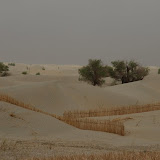
Takla Makan
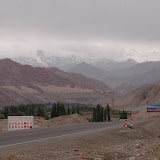
KKH
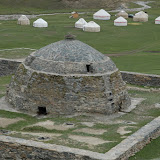
Kyrgyzstan


Highlights

Seeing and crossing the Takla Makan. Peter Fleming did this by horse and camel and took several months, we went across one of new ‘desert highways’ in an air-conditioned bus in about 6 hours. The Takla Makan really does fit all the desert stereotypes.

‘Doing’ at least part of the Karakorum Highway. I bought the KKH guidebook in the early 1990’s when I visited Pakistan’s Northwest Frontier Province – so it was high time I travelled along at least part of the route.

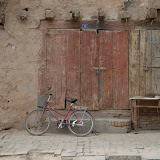
Seeing Kashgar before all the old bits get demolished. The name (for me) conjures up images of camels and a dusty oasis town – there are still a few camels, and it’s still dusty in places, but there are now an awful lot of new buildings too. A lot of building and demolition work going on at the moment involves removing big chunks of the (mainly Uighur) old town – lots of 500 year buildings are being bulldozed as potential earthquake hazards. They can’t be that vulnerable to earthquakes if they’re been there for 500 years.

Learning about Uighur culture. I didn’t know a huge amount about the Uighurs before we booked the trip – it was fascinating to learn about the culture and to meet lots of very friendly and welcoming Uighur people.

Staying in a Yurt These are the traditional tents used in the high mountains in Central Asia – I’ve now spent two nights sleeping in them. And I remember at least some of the reasons why I retired my tent and promoted myself to places with hot and cold running water.

Having a city-break in Bishkek. OK, it’s a long way from the UK for a city break – but Bishkek is an fantastic place to spend a few days, a mix of Central Asian cultures, Soviet-era architecture and western comforts.

Lowlights

Chinese Breakfasts. I love Chinese food – and almost all the evening meals were either Chinese or (more commonly) Uighur, but I really can’t manage Chinese breakfasts. The group got to the stage of fantasising about muesli with cold milk – and the reaction on discovering that we would get the option of porridge once we crossed the boarder into Kyrgzstan was close to hysteria.

Long-drop toilets. There are some occasions when I feel the need to offer thanks that I have a really awful sense of smell – this holiday provided many such occasions.

My other half has posted some of her thoughts on the trip http://susannareeceknits.blogspot.com/

We did this trip with Explore! – ‘Crossroads of Asia’ – and thanks to all our companions, to Ali and Olga our local guides – and particularly to Craig our Explore! Tour Leader.