Round the World in 20 days.


Having established that east is best (see previous post), how long would it really take to get round the world mostly by train?

Let's assume for the sake of argument that I'm going to set off eastwards tomorrow - at midday on Monday, 10th September 2012.

I'll catch the 12:01 from Oxford to London Paddington, then cross London to St Pancras to catch the Eurostar at 15:04, I'll be in Brussels just after 18:00, and in Cologne in time for dinner before catching the 22:28 heading eastward towards Moscow.

After a couple of nights and the intervening day, I'll get into Moscow's Byelorruski station at 09:37 on Wednesday morning.  The best direct train to Vladivostok, the Rossiya, runs every other day, so I've given myself the luxury of a static bed and time to have a look around Moscow before heading to Yaroslavski station on Thursday evening for the 23:45 departure and the long haul to Vladivostok, via Perm, Omsk, Krasnoyarsk, Ulan Ude and finally, after 9258 km, into Vladivostok in time for breakfast on Thursday 20th September. 

I'm going to forego the delights of Vladivostok, and head to the airport to catch the Korean Air flight to Seoul, where I’m going to reward myself with a static night before the overnight "time travel special" from Seoul to Vancouver (AC064) where by the quirks of the International Date Line I'll both depart and arrive on Friday 21st September.  Vancouver is one of my favourite North America cities so I’m going to make the longest stop of the trip and have a two night stop-over, before heading to Pacific Central station in Vancouver in time for the Sunday (23rd) departure of 'The Canadian' at 20:30.

I'm expecting to haul into Toronto station at about 09:30 on the 27th, before catching Train 60 to Montreal, then changing again for Train 14 to Halifax in Nova Scotia. That's another overnight train ride, which gets me into Halifax just after 17:10 on the 28th.  This time there’s not really enough time for sightseeing before I head to airport for the Air Canada (AC860) flight to London which gets me back into London at 09:35 on the 29th September, and I would expect to be back in Oxford by mid-day, about 456 hours after I left.

I played with a few variants of this trip, and found that the real trick to doing the trip quickly is getting the long train journeys to connect.  The Rossiya runs every other day, and the Canadian appears to run twice a week at this time of year.  A variant of this trip starting from Oxford on Sunday 9th got me back into London on Monday 24th – only 16 days.

If you're trying to track me down over the next few days email is probably the best bet, I’ll probably be in the office, but you never know. It'll all just depends how I feel tomorrow morning. 

The information in this post came from lots of websites – including Trainline, Man in Seat 61, Real Russia, Expedia, AirCanada and ViaRail.

My ‘final’ itinerary was

1
Monday 10 Sept
12:01 from Oxford, arrive Cologne 20:15, 
train to Moscow dep 23:45
2
Tuesday 11 Sept
En route
3
Wednesday 12 Sept
Arrive Moscow 09:37
4
Thursday 13 Sept
Depart Moscow 23:45
5
Friday 14 Sept
Perm (at 20:08),
6
Saturday 15 Sept
Omsk (14:03),
7
Sunday 16 Sept
Krasnoyarsk (09:36),
8
Monday 17 Sept
Ulan Ude (09:50)
9
Tuesday 18 Sept
Still on the train
10
Wednesday 19 Sept
And still on the train
11
Thursday 20 Sept
Arrive Vladivostok 06:17, to Seoul (KE982)
12
Friday 21 Sept
Dep Seoul & Arrive Vancouver (AC064)
13
Saturday 22 Sept
Static in Vancouver
14
Sunday 23 Sept
Depart Vancouver 20:30
15
Monday 24 Sept
Jasper (16:00), Edmonton (23:00)
16
Tuesday 25 Sept
Saskatoon (09:10), Winnipeg (20:30)
17
Wednesday 26 Sept
On the rails
18
Thursday 27 Sept
Arrive Toronto 09:30, dep 11:35
Arrive Montreal 17:07 dep 18:30
19
Friday 28 Sept
Arrive Halifax 17:10, Depart 23:45 (AC860)
20
Saturday 29 Sept
Arrive LHR 09:35, back to Oxford by 12:00


Travellers Torment


I usually really enjoy travel planning, but last night I lay awake trying to get my head round a travel conundrum. Should I do a round-the-world trip eastward or westward?


Image of diesel train about the leave Narvik station
Narvik to Boden - not quite
the Trans-Siberian
Yesterday I found myself thinking again about the Trans-Siberian railway.  The guide book has been on the shelf for a few years, and every now and again it comes to hand, usually when I'm looking for something else.  I started browsing it again, and the contemplation developed into the idea of how much of a round the world trip can be done by train.  Across Europe and Asia - Oxford to Vladivostok - no problem. Eurostar to Brussels, overnight to Moscow, then TS to Vladivostok.  Across North America - Vancouver to Halifax- easy. The Canadian to Toronto, then on to Montreal and Halifax.  And I don't have a problem with accepting that the Pacific and the Atlantic need to be crossed by plane or ship rather than by train. 

What I do have a problem with is the International Date Line.

Image of Vancouver waterfront
Vancouver - Coal Harbour
In addition to travelling I also take a lot of pictures, particularly I have a serious picture-a-day habit.  This means I need to take at least one photograph every day.  For the last couple of years I've been posting these on Blipfoto, but my uninterrupted picture a day sequence runs from 24th December 2004. As of 8th September 2012, that was 2816 days and I'm not keen on breaking the sequence. That was what was keeping me awake last night.  What's going to happen when I cross the International Date Line?  In the wee small hours I just couldn't figure out what was going to happen to my days as I crossed the line, and what difference the direction makes.

In cool light of morning, and with a little assistance from the other half, I think I've convinced myself that provided I keep travelling east, the worst that can happen is that I get the same day twice (at least that's what happened to both Phineas Fogg and Michael Palin). If I travel west I might, depending on when during the day the clocks actually get changed, wind up skipping a day completely and wreck my photo sequence.

Or I could just leave my camera clock permanently set to UK time, and just make sure I take at a picture every few hours, just in case.

Olympic Weekend - London – July 2012


In the great Olympic Ticket Lottery earlier this year I applied for lots of tickets all over London.  The one event I got a ticket for was the Archery session on Saturday afternoon 28th July.  I have to confess I was little bit miffed to only get a ticket to this one event, and at the one Olympic venue (Lord’s Cricket Ground) I’d already been too, and to be honest until fairly recently I wasn’t really looking forward to the event.

Maybe I was falling into the media-driven trap of thinking that the organisation wouldn’t be good, the transport won’t work, London would be too crowded and the weather would be rubbish.

I really couldn’t have been more wrong.  I had a fantastic day in London on Saturday – the place was heaving with people, but everyone seemed to have a smile on their face.  The staff from Southwest Trains offered me an ice-cream as I stepped off the train.  The Olympic volunteers were brilliant – about 10% of the London population seems to have an Olympic badge and they really did make London seem like a fantastically welcoming place.  The people in the shops I talked to were friendly and cheerful.  The crowds on the streets were friendly and cheerful. Even the queue to get in to Lords was happy.  I’ve never had my bag x-rayed by someone with such a broad grin.  I was thoroughly awash with Olympic spirit before I even got to my seat. 

Lord’s has had a makeover unlike any it’s seen before – they’ve constructed a purpose-built archery arena on the main playing area.  Arrows get fired from the Pavilion End over the square to targets in front of the main press box at the Nursery End.  The archery arena works really well.  The welcoming steward showed me to my seat saying “You’ve got a great seat there – mind you, they’re all pretty good”.  He wasn’t wrong, all 5000 of us (and contrary to some of the media grumbles from elsewhere, there were very few empty seats) had excellent views. I think every seat had an unrestricted view of the archers, the targets and the big screens and scoreboard.


Over the course of a four-hour session in glorious sunshine, we saw eight matches as the men’s team event went from having eight teams, through to an incredibly tense final between Italy and the USA – which the Italians won by scoring a 10 (a bulls-eye) with the final arrow of the event to win by a single point.  I’ve cheered plenty of fours and sixes at Lords – Saturday was the first time I’d cheered tens.  And to top it off, we got to see the medals awarded and to cheer the Italian national anthem.

And of course, since the day was perfect – the crowds leaving the ground where good humoured, and the transport both in and away from London worked just as was promised.

To round off the weekend I headed to darkest Surrey to both visit my parents, and to try and see a bit of the Woman’s Cycling Road Race on Sunday.   In addition to climbing it’s way around Box Hill a couple of times, the race organisers had figuring out a route through various parts of Surrey including West Byfleet.  The weather on Sunday didn’t quite live up to the standards it had offered on Saturday – but the folks of Surrey were determined not to let the occasional thunderstorm detract from the chance to cheer on the cyclists as they hurtled at high speed down the roads and lanes of Surrey.  I found a suitable corner where it seemed that the cyclist would need to slow down.

I spent a fun hour standing in the rain (can’t think of having written that too many times) waiting for the cyclists to appear.  The crowds were happy and cheerful despite the rain.  The Olympic volunteers in their official waterproofs and with their official umbrellas were happy and cheerful.  The police escorting the race seemed to thoroughly enjoying their day out too.  


And the cyclists? 


They were moving too fast to figure out if they were enjoying the event at the time – the group, despite having slowed for the corner, went past me in about 7 seconds (just long enough to take a few pictures).  The photos I saw afterwards of Lizzie Armitstead certainly suggest that she’d enjoyed the day overall almost as much as I’d enjoyed the weekend.


A few more of the pictures I took are now on Flickr

Now, where can I get some Olympic tickets for next weekend.

Independent Travel


In an attempt to restore some order to my home workspace I was clearing out some of the many travel-related fliers currently balanced precariously on the end of my desk. As I cleared the pile I realised that I was making some big assumptions about the sort of travel I was planning, and the places I was thinking about travelling to.  Some of the rejected leaflets were about places in the "Don't want to go there" category, others were in the "Been there, and have got too many leaflets already" category.  A more interesting distinction was between the places where I thought I needed support and assistance to travel (where I was keeping the leaflets), and the places where I'm happy to plan and book independently, or to just to figure out as I go. 

On reflection, I think there are four different sorts of travel, and although there are still some parts of the world I've not been too, I've done trips in all four categories

Option 1. Wing It

Glacier National Park, Montana - hardly booked at all.
Developed English-speaking countries that I've been to before are the easiest ones for me to put into the easy, independent, no-forward-planning-needed category.  There are very few instances over the last 20 years where I've thought it necessary to 'buy in' expertise for trips in the UK or to North America.  In the case of the USA or Canada, most recent trips have been work-related where itineraries were business driven, but for leisure trips I've tended to make up itineraries on a day-by-day basis.  A few years ago we spent three weeks travelling in the US Rocky Mountain states.  We booked flights to Denver (which got messed around by baggage chaos at Heathrow), a rental car (which expired halfway through the trip), and the first two nights accommodation (one of which evaporated on the back of UK airport chaos).  The rest of the trip was figured out as we went, the main agenda item over dinner each evening was “where do we want go tomorrow?”, and the usual post-dinner activity was to book the next motel.  On a couple of mornings we rethought plans based on the weather, and at one point we even talked about driving South until the rain stopped.  The unplanned style of the trip was one of its many attractions, and the flexibility meant that when we needed to factor in several hours in a car dealership in Whitefish, Montana while they tried unsuccessfully to figure why our car had been reduced to having just one openable door (not the driver’s door either) it wasn't a major problem.  I know some travellers like to go a step further and don't even book their hotels in advance at all, this doesn’t suit me - I prefer having a firm target at the end of the day, so I can linger waiting for the light to be right for a photograph without worrying that I’ll wind up needing to sleep in the car.


Option 2. Book Independently

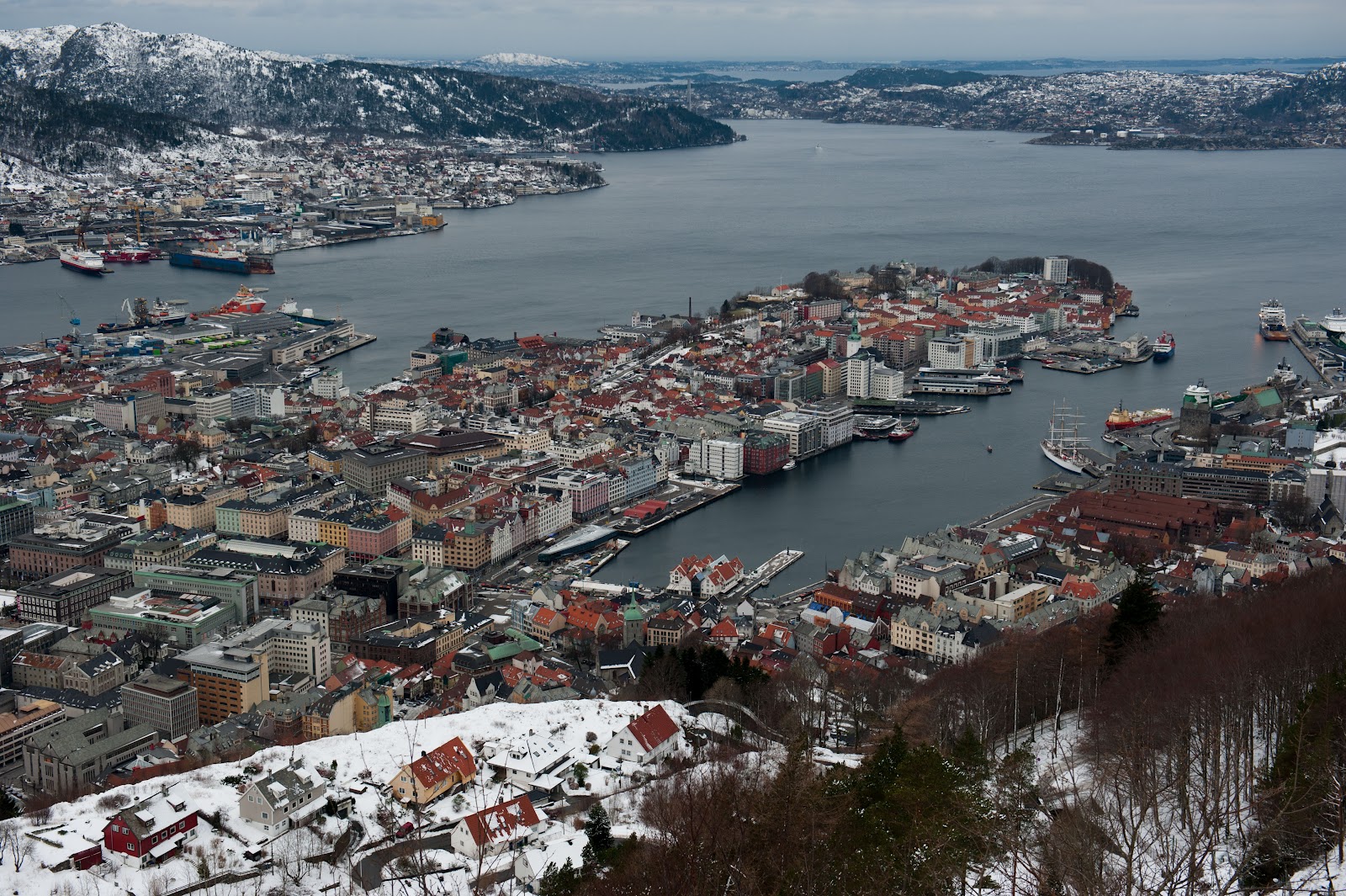
Bergen, Norway - booked independently
If I'm going to travel around North America in peak travel season, or I need to be in particular places at specific times, I do almost always book hotels in advance.  I also tend to book almost all of my European travel on this basis.  I probably over-research and over-plan at times, but my excuse for this is that I really enjoy travel planning.  I enjoy stitching together a complex itinerary, and figuring what I can see and do, and how I'm going to do it, and in Europe it is generally possible to rely on the timetable and schedules that are published.  A recent example of a trip put together in this way was my Scandinavian trip in February.  I spent two or three days in January deciding where I wanted to go and how long I wanted to spend doing it, then used a collection of different websites to book the entire trip. My booking strategy was to start by booking the 'hardest' bits first.  These were usually the most restricted bits, for example where I wanted to be on a particular boat, train or plane.  For me the most 'restricted' bit was the wish to travel along the Norwegian coast on one of the old Hurtigruten boats.  The next step was the flights and the long distance trains where there is some flexibility.  Step three was to figure out where to stay in places with limited accommodation - for example little towns where there weren't likely to be too many hotel rooms available.  The final stage was booking hotel rooms in big cities - where there was never going to be a shortage of accommodation, and the only real reason for booking ahead was to get a good room rate. I didn't get round to booking these until a couple of days before I travelled. 

If it's practical, this in definitely my preferred way to organise a trip!  Maybe one day I'll figure out how to make some money out of choreographing trips this way for other people.

Option 3. Choose to let someone else sort it

The third category of travel involve the trips where I either (i) enlist a specialist operator to tailor a trip to my specification - and am prepared to let them do the legwork and be paid for it! or (ii) book a pre-arranged trip. I tend to do these where I don't feel that I know the region I’m planning to go to well enough, where I can't figure out how to stitch together the itinerary I want or where I just don’t trust the information I’ve got.  When I think about these sort of approaches I tend to think about trips to the Indian subcontinent or to South America. 

Sri Lanka, UK organisation by Wildlife Worldwide, ground agents Baurs
We took this tailored itinerary approach for our Sri Lanka trip last year.  We found a specialist wildlife tour operator in the UK, and asked them to put together an itinerary.  In practise when you go down this route you are relying on the operator knowing more than you (which isn't always the case) and on the operators choice of a good local agent to sort stuff out on the ground and actually make the trip happen.  On our Sri Lanka trip I wasn't always convinced that the UK agent knew much more than we did, but they did choose a very good local agent.

One of the questions that I’m always left with for a trip like this is whether it’s better to use a UK agent as your main point of contact or if you should go directly to a local agent.  I can think of two recent trips where I’ve used UK agents who then used a local agent (Baurs in Sri Lanka and Blue Poppy in Bhutan), and one example where I used a local agent directly (Falkland Islands Holidays).  The upside of using a local agent directly is potentially getting more direct information about places to see and maybe being able to negotiate costs, the downside is that you won’t get things like ATOL protection or probably the ability to pay by instalments or by credit card. And, if the local agent doesn’t have a presence in the UK at all, sending money to them can involve an fascinating exploration of the international banking system.

A simpler (and sometimes cheaper) version of the tailored trip is one where you opt to join a pre-arranged trip with a number of other people.  One of the attractions of this sort of trip is that you are probably going to be looked after from dawn to dusk (and often later) each day.  This allows you, if you wish, to decommission your brain for the duration of the trip.  You get up when you are told, get on the bus when you are told, and eat your meals when you are told. If the trip is an escape from e.g. work pressures at home, this can be good.  On the flip side, I've found that after few days there seems to be a herd culture that develops within the group which appears to make decision making impossible.  I still have vivid memories of an afternoon in Kashgar in western China where our tour leader decided to give us an afternoon “at leisure” with the instruction that we should find our own way back to the hotel (a short walk we’d done with him several times) when we were ready.  This induced a level of panic amongst several of our fellow travellers reminiscent of your average flock of sheep.  Only a few days earlier the same individuals had joined the trip as confident, thinking travellers!

Option 4. Hand-holding required

The final category of trip are to those places where it just isn't possible to travel independently. This can be a consequence of geography (there really isn't any local infrastructure to book) or of politics (local rules designed to prevent independent travel).  I've done trips of both types.  The polar voyages (to the Antarctic, South Georgia or Svalbard) rely on travel groups being self-supporting, and short of chartering and provisioning your own boat and hiring your own guides you have no choice other than to join an organised trip (at least not at the budget levels I live at). 

Bhutan - UK organisation by Cox and Kings, ground agents Blue Poppy
Some countries also put lots of hurdles in place to ensure that they don't have independent travellers wandering around.  I retain a residual suspicion of places where this is the case.  In China (when we visited Xinjiang) I felt this was all about trying to control what visitors got to see and where they went, and it was clear that we were being monitored most of the time.  In Bhutan we also needed to travel with local guides, but I felt that this was for much more constructive reasons.  The government there have been trying to manage the growth of the tourist industry, and attempting to prevent the tourist over-run that happened in Nepalese as the tourist industry developed.  In these places you don't really have the choice of how you put a trip together - the paperwork and bureaucracy involved with trying to travel independently is likely to be so overwhelming that you really have no option but to sign up with an experience operator.

So what’s the best way to travel?

The answer is going to vary from place to place.  I’ve had great trips using all four models.  If I have the choice, I’ll always opt for independent travel that I’ve planned and booked myself.  There are some places, and times, that where this isn’t realistic and in these cases I’ll opt for one of the other approaches.   Any travel gives you the potential to see and explore new places and to meet new people.  In some cases travelling independently gives you options for exploring places in your own unique way.  In other cases you need the support of either tour operators or fellow travellers to get the most out of a new destination.


(This piece nearly took a dramatic turn for the worse, when my spellchecker decided that my title was supposed to be "Indecent Travel".   I'll save that post for the post-watershed blog)

Boats and Ice

Until a few years ago the mention of the word ‘cruise’ would have sent me into mild panic – the idea of being trapped with several thousand other people interested only in the theatre shows, bar or dining rooms sent a cold shudder up my spine. And the only time you get let off the boat is to mill around an over-crowded resort with the same several thousand people.

There are other cruises where the tone is very different – expedition cruises.  The emphasis on these trips is on the “expedition” bit rather than the “cruise” bit.  The boats are small, the itinerary is often vague, the meal times subject to change and dressing for dinner might involve finding a clean T-shirt – and you are very likely to get tannoyed out of your bed in the middle of the night too.

I’ve been on four “small boat” trips in recent years.  Three of these fall into the ‘expedition cruise’ category and a fourth trip, along the Norwegian coast which although it followed a rigid timetable had lots of the other elements of expedition cruising.  In this post I’ll say a little about each voyage – there will be a further post about each over the next few weeks. In addition to involving small boats, the other thing all the trip had in common was snow and ice.


The first trip was on MS Fram with Hurtigruten.  Hurtigruten are best known for voyages up the Norwegian coast, but they also run voyages in the Arctic in the northern summer, and in the Antarctic in the southern summer.   The MS Fram was purpose built for polar tourism, and although it can carry close to 400 passengers, in polar regions it usually sails with a maximum of 200.  This means lots of space on deck, and plenty of chances to get ashore.  My trip on the Fram started in Ushuaia at the southern tip of Argentina, and then headed due south to the Antarctic Peninsula.  We signed up for what the guidebooks call the ‘classic’ Antarctic Peninsula itinerary.  This is an 8-day/7-night trip from Ushuaia – with the intention of getting across the Drake Passage as quickly as possible and spending most of the time on the peninsula.  MS Fram is probably the ideal boat for a first trip across the Drake Passage – it’s very fast and it’s very stable.  If you’re lucky, the seasickness ‘on the Drake’ won’t be too bad, and even if it is, it’ll only take about 36 hours to get across to the relative shelter of the South Shetland Islands. Once across the passage the expedition crew will figure out a suitable itinerary probably taking in about 6 or 8 of the 25 or 30 regularly used landing sites either in the South Shetlands or on the peninsula itself.  The time you get ashore at each of the possible landing sites will be depend on the weather and also on how many fellow passengers you have.  While the Fram is an ideal ship for crossing the Drake Passage, it’s one downside, once you’re across the Passage, is that the boat is likely to have close to 200 passengers on board.  Under the terms of the IAATO (International Association of Antarctica Tour Operators) Charter – the ground rules for all the ships operating in Antarctic waters – ships are only allowed to put 100 passengers ashore at a time. If you are on a really small ship, this means that everyone can get ashore for the full time available for the landing. On a bigger ship, like the Fram, this means that shore time needs to be limited to ensure that everyone gets time ashore at each landing site.  I’ll say more about the landing sites in the next post, and say something about the wildlife at each location too.


My second expedition voyage was to the far north.  I spent a fantastic eight days cruising around Svalbard on a converted Russian spy ship.  The “Akademik Sergey Vavilov” was built for the Russian Academy of Science in the 1980’s as a “hydrographic research” ship and is now run by Quark Expeditions.  It’s a small ship, carrying just over 100 passengers, and is ideal for wildlife watching. It was designed to run very quietly for its “hydrographic research” which makes it perfect for stalking wildlife. I joined a trip in June 2010 where the boat been chartered by Exodus as a photographic charter searching for polar bears.  We joined the ship in Longyearbyen and then spent the next seven days searching for (and finding) polar bears, walruses and huge numbers of sea birds.  We spent many hours exploring small fjords in inflatable boats getting amazingly close to polar bears.  One real bonus on a trip to the High Arctic in  summer is that it doesn’t get dark – the downside of having fantastic scenery and wildlife to photograph 24 hours a day, is that after a few days sleep deprivation kicks in.  Another bonus of a summer trip to Svalbard is that the weather is likely to be pretty good, and there isn’t a reach of exposed sea to cross before the wildlife appears, unlike the Drake Passage which always seems to do its best to protect Antarctica from visitors.  I wrote a blog post about Svalbard at the time of the trip, and I’ll be adding another post as part of this series.

After visiting the far north, it seemed obvious that the next trip should be back to the south.  When I came back from the Fram trip I looked at the brochures to try and find my next southern voyage should be.  I had done a land-based trip to the Falkland Islands but the landmark location I needed to add to my collection was South Georgia.  Several operators offer trips that take in the Falklands and the Peninsula along with South Georgia – but although these trips were attractive, they all involved a lot of sea time and limited time at each location.  Eventually I came across a trip operated by a Dutch-based company called Oceanwide Expeditions, who were proposing a 14 night trip from Stanley in the Falkland Islands, spending 8 or 9 days around South Georgia.  All the other itineraries offered 2 or 3 days there, so the much longer time on site was a real attraction.  The Plancius was originally built for the Dutch Navy, but was converted to become a tourist boat a few years ago.  Having sailed from Stanley, the Plancius headed east across the Scotia Sea for 72 hours crossing the Antarctic Convergence, the line in the ocean where the Antarctic starts – in biological and climatic terms at least, until it reached the western tip of South Georgia.  The Scotia Sea isn’t quite the same challenge as the Drake Passage, but it is definitely enough to make carrying soup across the dining room interesting at times.  The next eight days were mostly spent ashore amongst huge numbers of penguins and seals, and at sea in the company of killer whales.  On the Antarctic Peninsula there are usually several other tourist ships around, and one of the skills of the expedition organisers is to ensure that two ships don’t plan to use the same landing site.  In South Georgia there are rarely other ships around, so the chances of meeting another group is pretty limited – this just adds to the sense of isolation of the island. The biggest challenge around any landing in South Georgia is likely to be the weather which can change very quickly.  We were incredibly lucky in only missing out on a couple of landing attempts over the whole visit.   My blog post from late 2011 gives a flavour of the trip, and I’ll saying more about the various landing sites in a later post.

My fourth trip, and most recent trip, was a little different.  It was back with Hurtigruten, but this time doing what they are best known for, i.e. hauling up and down the Norwegian coast.  On this route Hurtigruten run some very big boats, but I opted for MS Lofoten, one of the smallest and oldest boats in the fleet.  This ship was built in 1964 and still, the crew proudly say, has the original engine.  The newer boats in the fleet ripple with modern technology but the Lofoten has classic charm and lots of wood.  I joined the boat in Bergen then spent the next six days sailing north to Kirkenes, before turning round and heading back down to Svolvaer in the Lofoten Islands.  In the summer the sun rarely dips below the horizon and gives endless photographic opportunities, but in February the nights are long and dark.  However, if you get lucky, the deck of a Hurtigruten boat can be the perfect place to watch the Northern Lights.  The Coastal Voyage doesn’t have the unpredictability, in terms of schedules, of the other trips, it does however have the informality of an expedition cruise, with the crew always being ready and willing to point out the landmarks as you sail past them, and to organise excursions at lots of the ports of call. The other attraction is the ever changing group of passengers.  For many Norwegians  who live along the coast, this is the way to travel, and they hop on and off the boat as we do trains.

Over the next few weeks, I’m planning to say a bit more about each of these voyages.  They all provide a wonderful way to get close to the landscape and wildlife in some very remote places, and to do so at a sensible place.  In almost every case these ships allow travellers to get to places than just can’t be reached in any other way.


Petra - The Rose-Red City


There’s a bandwagon around – it's 200 years since Petra was rediscovered – so I thought it was time to jump on.

If you’ve been fortunate enough to spend a few days working in Amman in Jordan, and it’s a few days until your next meeting, there probably isn’t anything better than to hail a taxi, and head south to Petra.

Getting to Petra

There are two roads from Amman to Petra. There’s the new Desert Highway which goes straight to Ma’an, before turning off to Petra and Wadi Musa which takes about three hours, and there’s the old Kings Highway which twists and winds its way past a series of little towns and crumbling castles which takes much longer. My taxi driver wouldn’t hear of my using the Desert Highway for my first visit to Petra.  He was insistent that to see the real Jordan you needed to do what travellers to Jordan have been doing for hundreds of years, and follow the route of the ancient Kings.  True to his word we stopped at crumbling crusader castles at Karak and Shobak, we ate fresh hot bread from roadside bakeries, we went through the Wadi Mujib, we looked for (and found) black irises on the roadside, we visited the Dana Nature Reserve – and to top things off I wound up being dropped at the Crowne Plaza Resort Hotel in Wadi Musa.  I’d picked this hotel from the internet – and the feature in the description that got my attention was ‘200 metres from the entrance to the Ancient City of Petra’.   The hotel didn’t disappoint and I spent the evening sitting on a hotel balcony looking out onto the hills that surround Petra – the hills that give absolutely no clue as to what they are hiding.   Johann Ludwig Burckhardt probably sat somewhere nearby, albeit it in less comfort, in 1812 and wondered what he was going to see when he was taken into the city.

First Sight of the Treasury

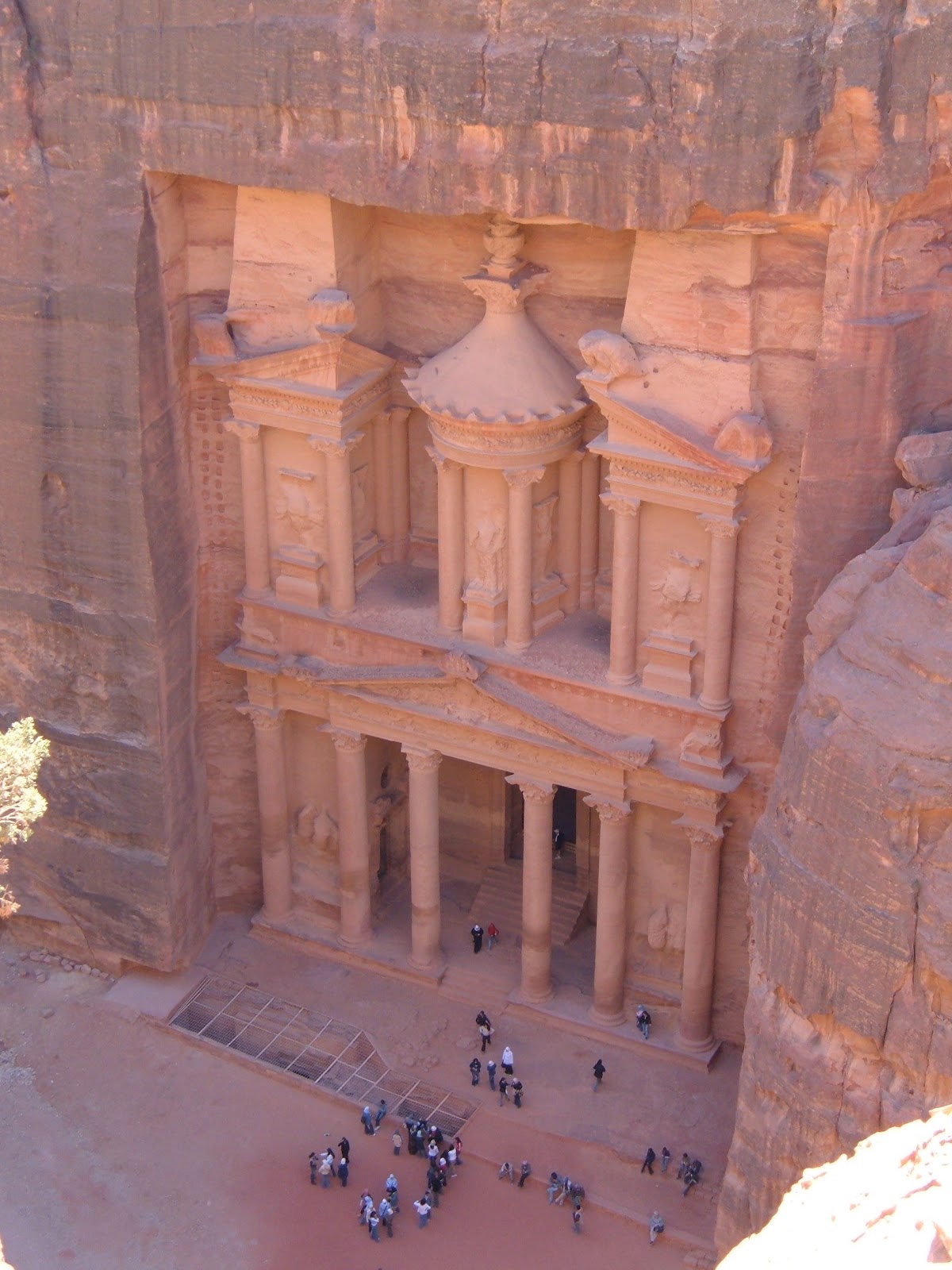
The real benefit of having a hotel close to the entrance is getting in early.  I was going to be able to spend two full days (plus a short visit early on a third day) around Petra, so I was first in line when the ticket office opened to get my three-day pass, and to start on the short walk down towards the gateway into the Siq.  The Siq, the narrow passageway into the city, and the Treasury at the far end of the Siq, feature in all the guide books to Petra and you might think that this would take away any novelty or excitement. It doesn’t.  The Siq draws you gradually down into the city.  As you follow each twist and turn, you hope for a first glimpse of the Treasury.  If it’s early in the morning you might disturb a few birds and the only sound is likely to be that of your own footsteps on the rock.  Eventually the Treasury appears between two curves of rock, looking exactly like it does in the guidebooks. But bigger.  And redder.

What the guide books really don’t prepare you for is the sheer scale of Petra.  The buildings, which were famous even before Indiana Jones visited, are spread out over a huge area, and over quite substantial mountains.

There are several different areas within Petra, some dating back to the Nabataeans, others to the later Roman occupation of the site.  The temples and tombs from the earlier period are in some places amazingly well preserved – the Treasury at the end of the Siq, and the Monastery high above the main (Roman) city centre being the most dramatic.  The sequence of elaborate tombs carved into the cliffs also raise graveyards to a whole new level of grandeur.

The High Tops

Once you’ve seen the Treasury and the city centre, it’s time to start climbing.  The Monastery is the most visited of the remote sites, and in addition to the dramatic façade, the climb and the cliff tops beyond give fantastic views across southern Jordan.  On the other high points are dramatic sacrifice sites, some looking down onto the dramatic fascades.  My favourite was Al Madbah, or the Place of High Sacrifice. Some of the routes are easy to follow up staircases and well-marked paths, other are much less obvious and make the map you’ve been carrying worthwhile.

People

Until 1985, when Petra was added to the UNESCO World Heritage Site List, there were still people living in the caves around the old city.  Part of the deal for being added to the list was that the residents would be provided with a new village outside the old city boundary, which had things like electricity and water.  The other part of the deal is that the former residents were given permission to come into the old city and continue to act as guides or to run stalls and shops.  They do all these things, and also give the interested visitor the chance to talk about living in the caves.  Some of the residents were happy, and able, to talk in English and to tell me that the new houses weren’t as good as the caves.  The houses were too hot in summer, and too cold in winter while the caves stay at the same comfortable temperature all year round.  Other residents weren’t able to talk much English, but were still very able to communicate.  My strongest memory was encountering a young goat herd on one of the hill tops.  He gestured me over to the little camp fire he had nearby, and insisted that I have tea with him – we weren’t able to talk but I really enjoyed just spending a quiet few minutes sitting with him before I headed back to the crowds around the main sites.

Petra by Night

There are lots of tourist things to do around Petra, but if you only opt to do one thing to complement the walking and wandering, you should visit Petra by night.  The site closes at dusk, but on a few evenings the site reopens again after dark.  You are guided down to the entrance to the Siq by torchlight then left to find your own way down the Siq which is lit from end-to-end by candles, and around the Treasury, which is also lit by hundreds of candles, local musicians play.  I’m not sure that this really gives a realistic picture of which life might have been like in Petra, but it does give your imagination plenty to work with.


Logistics

Petra is really easy to reach from either Amman in the north of the country, or from Aqaba in the south.  Organised trips to Petra run from the big hotels in both cities, but only give you a very short time in Petra.  

There are lots of hotels in/around Wadi Musa, and although all the hotels offer lifts to the entrance gates, however I think there is a real plus to being within walking distance.  This makes it easy to get in early each day, and to be ahead of the crowds.  Petra does get busy, so go early – when it’s both cooler and quieter.

Two days is barely enough to see the big sights, and get a feel for the place, so if you can manage three days do.  By the time you add in the climbs to the various temples sites around the hills you are likely to be pretty tired and foot-sore.   When I go again I’m going to take decent  walking boots, and if the final walk back up the Siq to the hotel is just too much, there are always going to be local taxis to take the strain.


Confession of a Travel Writer


I've heard it said that the difference between tax evasion and tax avoidance is about 5 years.  One is entirely legal, if not entirely commendable, and the other is definitely illegal.

I suspect there is a similar distinction in exams.  There are some practises which are clearly in the illegal category. Peering over your neighbours shoulder to see their answer to question 7 (tip: make sure neighbour knows more than you). Writing miscellaneous facts on your arm in the hope that the fact is needed and that you can roll your sleeve up far enough to locate said fact without attracting undue attention.  Both of these are illegal, and I've never done either. I was always far too scared of getting found out. 

I did however indulge in the examination version of tax avoidance (the legal option) - this was my first foray into travel writing.

Many years ago I did an O-level in German (for those from outside the UK, or just too young - a school exam typically taken at age 15 or 16).  I enjoyed most of the course ahead of the exam, had a reasonable vocabulary, had some clue about the grammar and could do the direct translation bits adequately.  However, the bit of the exam that always flummoxed me was the bit when you needed to write an essay (in German, of course) about some random topic set by the examiner. Net result was that I only just scraped a pass, at Grade 'C', not exactly an academic high point.

The next year, the O-level in French loomed.  Again I knew some vocab, I knew some grammar, but this time I wasn't going to let the essay get in the way.  Whatever the topic set by the fiendish examiner, it was going to include a journey. Monsieur Bleu was going to get on a train (or possibly a bus), the weather was going to be good (or possibly wet), he was going to buy a ticket (and get some change), he'd be able to reflect on what he was seeing out of the window, and possibly on some of his fellow passengers (which might well include either a cat or a dog).  And both he and I would satisfactorily complete our journeys. He to the bank or supermarket or beach, me to a significantly better grade than the previous year. Result, a first bit of creative travel writing. And, since you ask, a Grade 'A'.

This recollection of "travel writing" came back to me this morning, as I wandered round the fascinating 'Writing Britain' exhibition at the British Library.  The collection of items  'exploring literature and place' made me think about how much writing is actually travel writing.  Some strands of travel writing are about the journey - and I don't just mean Monsieur Bleu's bus trip - others are about place and experience of place.  A good writer is able to transport the reader into that other place, which is certainly the goal of a lot of travel writing.  The travel writer tries to capture place and experience, the fiction writer is trying to do that too, and to overlay a plot round the place and experience too.

The exhibition at the British Library covers almost all aspects of British life from rural living to 'dark satanic mills', the development of the suburbs and life at the coast.  It also covers, geographically, almost all of the British Isles, from Daphne du Maurier and Sherlock Holmes in the south west of England, via Shakespeare in the Forest of Arden, George Orwell at the end of Wigan Pier and Robert Burns at the Falls of Foyers.  My only disappointment was the very limited mention of the Shetland Islands.  The only reference I spotted was 'The Gray Wolf' by George MacDonald, which I've not read, but I gather includes Orkney, Shetland and werewolves.  And I thought the only wildlife I needed to worry about on Shetland was the occasional territorial bonxie.